AI predictive schedulers in 2026 are game-changers for social media engagement. Forget guessing when to post - these tools analyze your audience's habits, pinpoint the best times to share content, and deliver up to 40% more engagement. Posts timed with AI can rake in 50–150% higher engagement compared to random scheduling. Whether you're a solopreneur or managing accounts for a big team, these tools save 70% of your scheduling time and keep your posts ahead of the curve.
Here’s the deal: old-school "best time to post" charts are out. AI tools now track real-time trends, audience activity by region, and even device usage. They adjust as your audience’s habits shift, ensuring your content always lands when it matters most. Brands using these schedulers report 3.2x engagement boosts while slashing manual work by nearly half.
Quick facts:
- Top tools like Buffer, Hootsuite, and Sprout Social dominate, with prices starting at $6/month.
- AI-driven timing beats manual posting every time, especially on platforms like Instagram and TikTok, where engagement windows are tight.
- Expect smarter features like sentiment analysis, real-time adjustments, and even auto-replies to keep audiences hooked.
Bottom line? AI schedulers don’t just save you time - they make every post count. Ready to ditch the guesswork?
I Tested the 6 BEST Social Media Management Tools (Here’s the Winner)
sbb-itb-b3cfc51
What Are AI Predictive Schedulers?
AI predictive schedulers take the guesswork out of social media timing. These machine-learning tools dig into your historical engagement data, audience activity trends, and content performance to pinpoint the exact moments your followers are most active. Forget those one-size-fits-all "best time to post" charts like "Tuesday at 11 AM" - these platforms tailor recommendations specifically for your audience, based on how they actually behave.
The journey to today’s hyper-intelligent schedulers unfolded in three key phases. First came static scheduling, where you either manually picked posting times or relied on platform-wide averages that treated every audience the same. Then came tools with AI tools for social media content creation, but timing still involved a lot of guesswork. Now, in 2026, we’re at Level 3: systems that do it all - predict the best posting times, manage interactions, adjust for real-time audience sentiment, and even optimize your content before it goes live. It’s like having a social media manager that never sleeps.
These modern schedulers don’t just set and forget - they learn. Every post feeds the system more data, helping it track engagement trends and fine-tune its recommendations on the fly. If your audience shifts their habits - say, more people start engaging with your Instagram Reels during late-night hours - the AI adapts instantly. It even breaks down behaviors by geography and device, ensuring your posts hit the right people at the right time. For example, if your audience in New York engages differently than your audience in London, the scheduler adjusts for those regional differences.
The real magic? These platforms now factor in everything from algorithm delays to trending topics and global events, ensuring your content lands when it’s most likely to thrive. It’s not just about posting consistently anymore - it’s about posting smart. Every time. With real-time data driving the strategy, the engagement gains are undeniable.
How AI Predictive Schedulers Work
AI predictive schedulers thrive on a constant feedback loop. Every single post you share adds fresh data to the mix - whether it’s the time it went live, how many likes it racked up in the first 10 minutes, or whether it got shared or saved. With each new piece of information, the machine learning model sharpens its ability to predict the best times to post for your audience. It’s like having a constantly evolving playbook tailored to your followers.
These systems dig deep into specifics. Instead of just looking at overall engagement, they break it down into fine details: Are your followers more active on mobile during their morning commute or on desktop during work hours? Does your New York audience behave differently than your London followers? And what about content type - do educational carousels do better in the morning while promotional videos shine at night? For instance, if your audience loves how-to posts at 7 AM on weekdays but clicks on promo content at 8 PM, the AI ensures each type hits its sweet spot. It even handles time zone quirks, like avoiding a 9 AM Pacific post that would annoyingly land at lunchtime in Eastern time zones.
The smartest social media scheduling tools go beyond just timing - they’re tuned into the world. They can pause posts during global crises to avoid tone-deaf moments. Plus, they track Engagement Velocity, or how quickly your post racks up shares and saves in its first 10 minutes - a key metric since platforms tend to reward fast, meaningful interactions. And if your audience’s habits shift - say, a 20% jump in evening activity during the winter - the AI adjusts your schedule in days, not weeks.
Here’s the kicker: posts scheduled by AI can see a boost of 30% to 150% in engagement compared to off-peak publishing. That’s the power of pinpoint accuracy, running on autopilot 24/7.
2026 Advancements in AI Predictive Scheduling
The shift from static algorithms to real-time learning has completely reshaped predictive scheduling. AI schedulers today are lightyears ahead of where they were just six months ago. Thanks to real-time algorithm adaptation, these tools now use reinforcement and online learning to fine-tune predictions on the fly. This evolution has unlocked new levels of efficiency across platforms.
Gartner projects that by 2026, 40% of enterprise apps will use task-specific AI agents - up from under 5% in 2025.
Cross-platform optimization has also reached new heights. AI now recognizes the quirks of different platforms. For instance, Instagram and TikTok content fades fast, losing impact within hours, while LinkedIn posts have a longer shelf life. Advanced schedulers account for these differences, adjusting for "Algorithm Latency" - that critical window when platforms prioritize posts with high engagement in the first 10 minutes. They even tweak content styles automatically, ensuring posts on LinkedIn feel polished and professional, while Instagram content stays casual and visually appealing.
And it doesn’t stop there. Trend prediction accuracy has soared, thanks to what’s being called "precise post orchestration". These tools don’t just schedule posts; they pinpoint the exact moment to publish based on audience "Dwell Time" patterns and real-time sentiment analysis. Some systems even take over engagement duties, replying to comments and DMs to maintain the interaction momentum that platforms reward.
These advances are delivering real results. Brands are seeing a 3.2x jump in engagement and cutting manual work by 45%. AI-powered schedulers are also slashing planning costs by as much as 30% in 2026. For marketing teams, this means reclaiming over 15 hours a week that can now go toward strategy and creative projects.
The Science Behind 40% Engagement Boosts
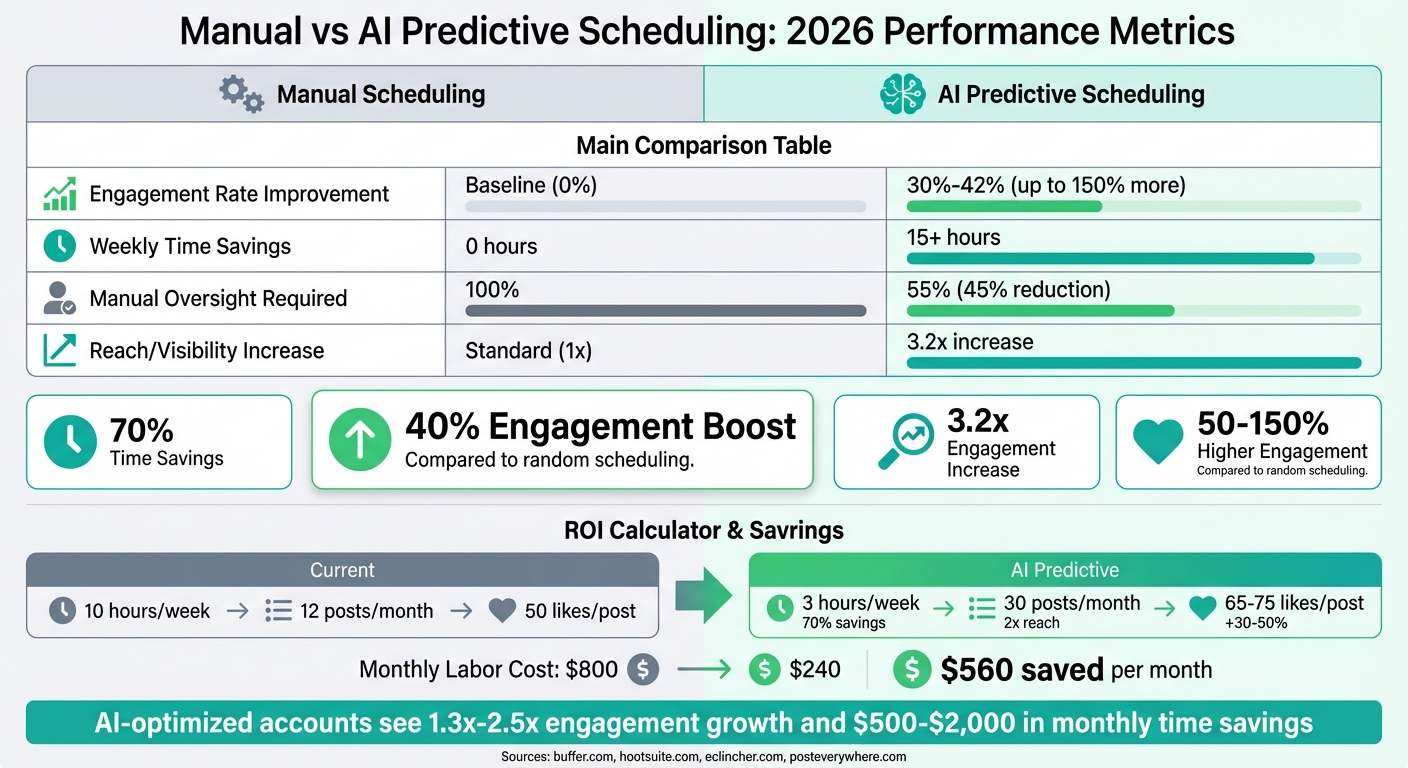
AI Predictive Schedulers Performance Metrics: Engagement Boosts and Time Savings in 2026
AI predictive schedulers don't just throw darts at a board when deciding the best time to post. They dive deep into historical engagement data - likes, comments, shares, saves, clicks - and match those patterns to the exact moments your audience is most active. The result? A tailored schedule that aligns perfectly with peak engagement times.
But it doesn’t stop there. These tools get smarter with every post, learning and adapting continuously. By factoring in geography, time zones, and even device usage, they create staggered schedules that hit your audience when they’re most likely to engage. Plus, modern AI social media automation suites track "Dwell Time" - the time users spend on your content - to fine-tune the timing for maximum impact.
As Eclincher puts it:
"Social media scheduling in 2026 has transitioned from linear queuing to predictive orchestration." – Eclincher
AI also steps up the game with content performance forecasting. Before you even hit publish, the system analyzes your post, predicts engagement rates, and suggests tweaks to boost performance. It focuses on driving those crucial first 10 minutes of engagement - shares, saves, and other high-value interactions - because platforms reward early activity. Some tools even A/B test on the fly, sending out two variations to a small audience and pushing the winner to the rest.
The numbers back it up. Brands using predictive orchestration report a 3.2x increase in engagement and slash manual oversight by 45%. Here's how the data stacks up:
| Metric | Manual Scheduling | AI Predictive Scheduling | Source |
|---|---|---|---|
| Engagement Rate Improvement | Baseline (0%) | 30%–42% (up to 150% more) | buffer.com, hootsuite.com, posteverywhere.com |
| Weekly Time Savings | 0 hours | 15+ hours | hootsuite.com |
| Manual Oversight | 100% | 45% reduction | eclincher.com |
| Reach/Visibility | Standard | 3.2x increase | eclincher.com |
And there’s another layer to this: real-time sentiment analysis. If a major global event unfolds, AI can instantly pause or adjust your scheduled posts to ensure they land at the right moment - not during a time when your audience is distracted or disengaged. Together, these advanced tools and strategies redefine how engagement is achieved, offering results that speak for themselves.
Top 7 AI Predictive Schedulers for 2026 Reviewed
Picking the right AI scheduler can seriously transform your social media game. The tools here promise to boost engagement by up to 40%, helping you maximize every post while cutting down on manual effort. Let’s dive into the top AI schedulers defining 2026 and what makes each one stand out.
Buffer
Buffer keeps it simple and affordable, perfect for freelancers and small businesses. Starting at just $6/month per channel for the Essentials plan (or $12/month for Team plans), it even supports Threads and Bluesky - platforms that still lack native scheduling options.
Key Predictive Features:
Buffer uses AI to fine-tune posting times based on real-time engagement insights. It also offers AI content creation tools for captions and image suggestions, giving you a head start on content creation.
Pros:
- Easy-to-use interface with budget-friendly pricing
- Handles multiple social accounts seamlessly
- Supports emerging platforms like Threads and Bluesky
Cons:
- Analytics are basic compared to pricier tools
- Lacks advanced sentiment analysis for larger teams
Real-User Engagement Stat:
Users report a 25% boost in engagement after switching from manual posting to Buffer’s AI scheduling.
Best For:
Freelancers, solopreneurs, and small businesses managing a handful of accounts on a shoestring budget.
Hootsuite
Hootsuite is built for teams and agencies that need serious automation muscle. Starting at $99/month for the Professional plan (covering 10 accounts), it includes OwlyWriter AI for bulk content creation and Heyday for auto-replying to DMs and comments. Its predictive analytics shine with features like "relevance velocity", which adjusts schedules to match platform-specific algorithms, such as TikTok’s critical first 10-minute engagement window.
Pros:
- Advanced social listening tools and bulk scheduling
- Automated replies powered by AI
- Strong collaboration tools for teams
Cons:
- Steep learning curve
- Higher cost may deter solo users
- Can feel overwhelming for smaller operations
Real-User Engagement Stat:
Agencies report over 30% engagement growth using Hootsuite’s predictive scheduling.
Best For:
Marketing agencies, mid-sized teams, and brands juggling 10+ accounts with complex workflows.
Sprout Social
Sprout Social is the go-to for enterprises needing top-tier analytics and CRM integration. Starting at $199/month per seat, it connects seamlessly with Salesforce, HubSpot, and helpdesks. Its AI Assist doesn’t just predict timing - it analyzes sentiment, triages customer support, and forecasts post performance before publishing.
Pros:
- Unmatched analytics depth
- CRM and helpdesk integration
- Sentiment analysis and performance forecasting
Cons:
- High price tag
- Overkill for smaller teams or creators
Real-User Engagement Stat:
Large businesses report up to a 40% engagement increase with Sprout Social’s predictive features.
Best For:
Enterprises and brands that need deep data integration and advanced team collaboration tools.
SocialBee
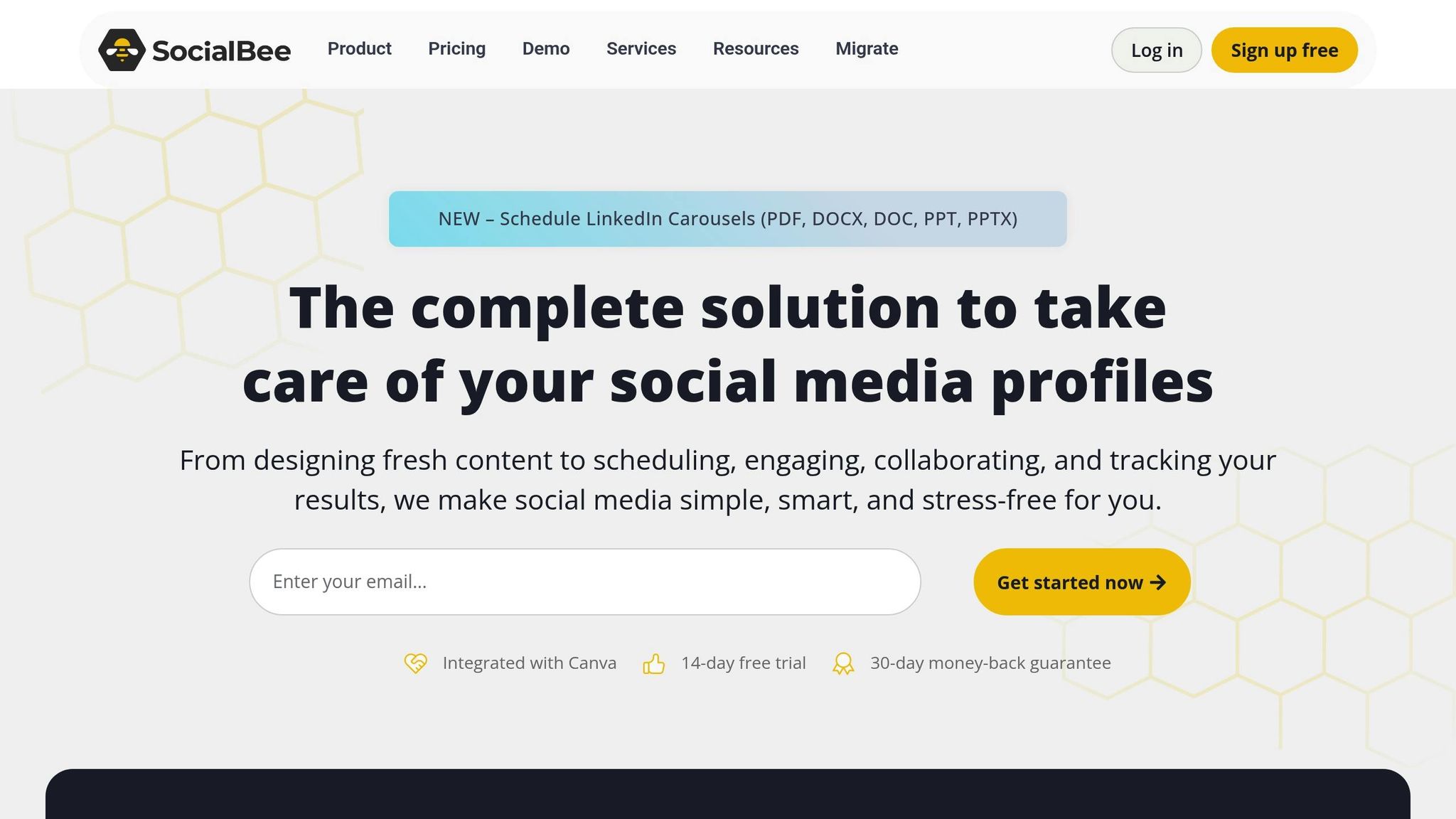
SocialBee strikes a balance between cost and features, priced at $25/month. It organizes content into categories (like promotional or curated) and uses AI to predict the best posting times for each category. It even adapts to seasonal trends, accounting for audience behavior shifts of 20–30%.
Pros:
- Affordable and easy to navigate
- Smart category-based scheduling
- Adjusts to seasonal audience changes
Cons:
- Limited platform support compared to competitors
- Analytics are good but not enterprise-level
Real-User Engagement Stat:
SMBs report consistent 15–25% engagement growth with SocialBee’s AI timing.
Best For:
Small-to-medium businesses looking for structured, budget-friendly AI tools.
Later
Later is the visual content planner every Instagram-first brand or TikTok creator needs. Starting at $25/month, it offers drag-and-drop calendar tools and AI timing tailored for image-heavy platforms. Its standout feature? Auto-clipping for video content, turning long clips into bite-sized Reels or TikToks.
Pros:
- Top-notch visual planning tools
- Instagram and TikTok grid previews
- Linkin.bio integration
Cons:
- Limited cross-platform capabilities
- Analytics focus mostly on visuals, not suitable for B2B strategies
Real-User Engagement Stat:
Visual-focused brands see 20–30% engagement lifts with Later’s AI timing and grid tools.
Best For:
Influencers, content creators, and brands prioritizing Instagram, TikTok, and Pinterest.
FeedHive
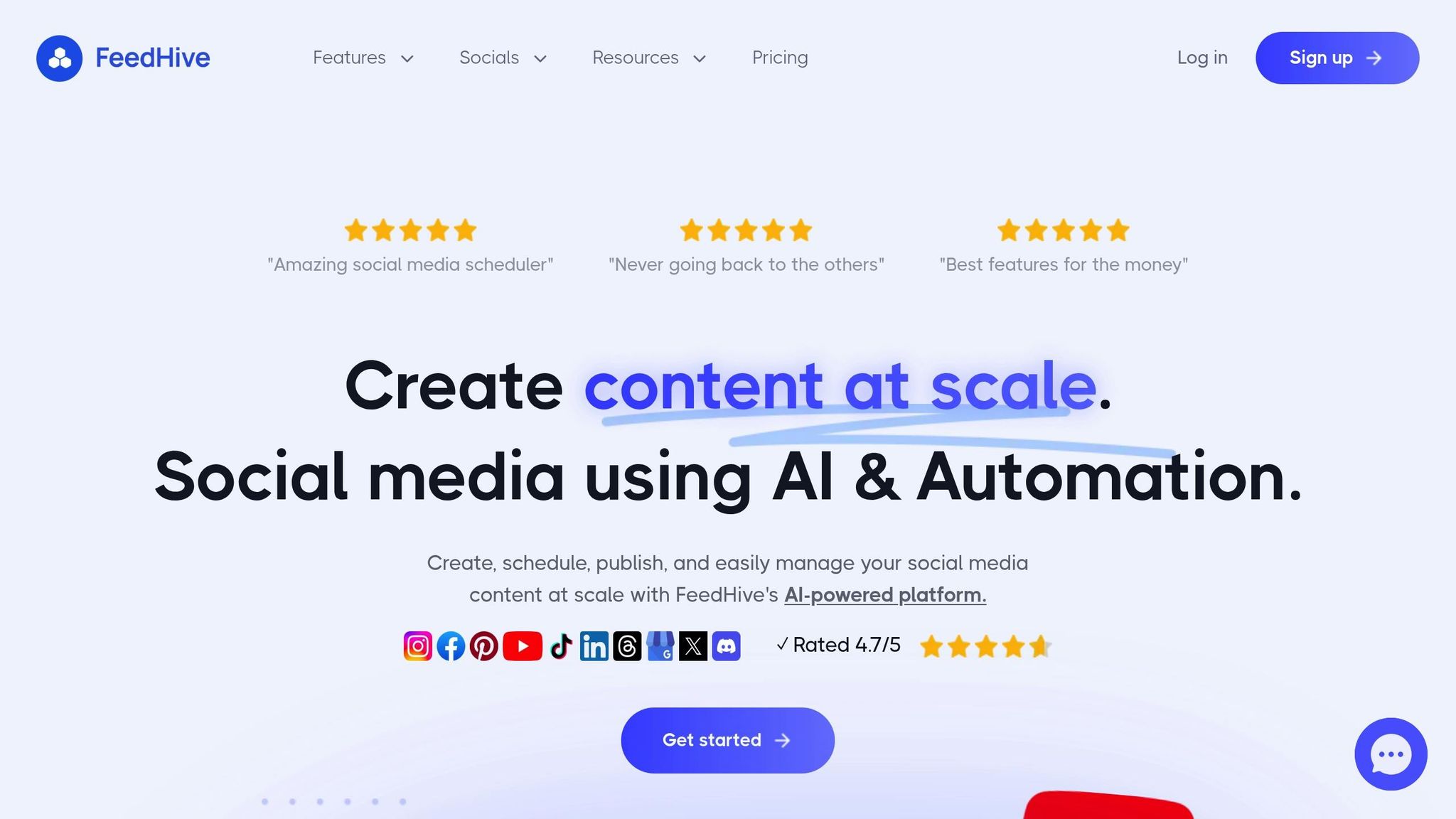
FeedHive is the new kid on the block, offering smart features like sentiment-aware automation. It predicts engagement rates before posting and even pauses content during global crises or when detecting negative sentiment. Positioned as a mid-tier option, it’s perfect for teams needing more than basic tools without breaking the bank.
Pros:
- Predictive engagement guarantees
- Sentiment-aware automation
- Expanding feature set
Cons:
- Fewer integrations due to its newer status
- Smaller user base may mean slower support
Real-User Engagement Stat:
Early adopters report 25–35% engagement improvements with FeedHive’s predictive tools.
Best For:
Growing teams wanting a blend of affordability and cutting-edge AI.
Blaze.ai

Blaze.ai is the heavyweight for content-heavy agencies. Its generative scheduling builds entire content calendars based on audience data and trending topics. With custom pricing, it’s geared toward high-volume publishers needing advanced tools like auto-clipping for video and ML-driven performance tracking.
Pros:
- Generative scheduling for full content calendars
- Machine learning for performance optimization
- Ideal for video-heavy strategies
Cons:
- Too complex for smaller teams
- Custom pricing can be steep
Real-User Engagement Stat:
Agencies report 30–40% engagement gains with Blaze.ai’s advanced features.
Best For:
High-volume content teams and agencies with demanding publishing schedules.
These tools all bring something to the table, whether you’re a solo creator or managing a massive team. The real game-changer? Picking the one that fits your strategy and budget while delivering consistent engagement boosts.
5-Step Implementation Guide to 40% Gains
Boosting engagement by 40% doesn't happen by accident - it’s all about following a clear, step-by-step plan. Here’s how to make AI predictive scheduling work for you.
1. Audit Your Current Engagement Data
Before you let AI take the wheel, you need to understand where you’re starting from. Connect your social accounts to your chosen AI scheduler and let it analyze 30 to 90 days of historical data to establish a baseline. Dive into your key engagement metrics to figure out what’s working. For example, you might find that your educational posts thrive in the morning while your entertainment content gets more traction in the evening. Study your top 20 posts to pinpoint when engagement peaks and map your audience’s time zones to align with local activity.
2. Select and Integrate Your Tool
Pick a scheduler that matches your budget and needs. Are you a solo creator? Buffer’s $6/month plan could be a great fit. Running a larger operation? Sprout Social offers enterprise-level features for $199/month. Once you’ve chosen, connect your accounts and let the tool analyze your historical performance. Most platforms need at least a month of data to start offering recommendations, but if you can feed it six months’ worth, you’ll uncover deeper patterns. Use branded links for better tracking, allowing the AI to tie engagement directly to specific time slots. With everything set up, the AI can start crunching numbers and preparing insights.
3. Train the AI with Historical Posts
AI thrives on data, and the more you give it, the smarter it gets. During its 30-day learning phase, the AI will analyze your past posts, looking at metrics like engagement rates, seasonal trends, and geographic differences. Organize your content into categories (like promotional, educational, or curated) so the AI can figure out which types perform best at specific times. This training period is crucial for building accurate predictions.
4. Run A/B Tests on Predictions
Don’t just trust the AI’s initial recommendations - test them. Use A/B testing to experiment with different posting times. For instance, try scheduling two versions of the same post to 10% of your audience at different AI-suggested times. Then, let the tool promote the better-performing version to the remaining 90%. Run these tests over four weeks to lock in the best time slots. Posts scheduled at AI-recommended times often see a 30% engagement boost, with fine-tuned timing adding another 5–10%.
5. Scale with Bulk Scheduling and Monitor ROI
Once you’re confident in the AI’s accuracy, it’s time to scale. Use AI-powered bulk scheduling to plan content across platforms, but don’t post everything at the same time - stagger your posts to match each region’s peak activity. For example, while Wednesday might be a strong day overall, LinkedIn engagement tends to dip on weekends. Keep a close eye on real-time sentiment to avoid missteps, especially during unexpected global events. Brands that pair AI-optimized scheduling with regular human oversight often report a 3.2× boost in engagement.
Common Pitfalls to Avoid
Even the best tools won’t save you if you fall into these traps:
- Inconsistent posting frequency: As Tim Eisenhauer from Apaya says, "Obsessing over posting times while posting sporadically is like optimizing your running form while lying on the couch."
- Relying on generic benchmarks: Platform-wide averages don’t reflect your audience’s unique habits.
- Uniform posting across platforms: Each platform has its own rhythm - LinkedIn thrives during work hours, while others peak in the evening.
- Over-automation: Posting three high-quality, AI-optimized posts per week beats spamming ten low-value ones.
Here’s the kicker: AI-optimized accounts only pull further ahead over time. Follow these steps, and you’ll be set to measure tangible improvements and assess ROI in the next phase.
Real-World Results and ROI Calculator
Let’s talk numbers - because nothing proves a point like real-world wins. Businesses of all shapes and sizes are seeing tangible results from AI scheduling tools. Take this mid-sized agency juggling 15 client accounts. They ditched manual scheduling for AI-driven timing in January 2026. Six months in? A 40% boost in engagement on Instagram and LinkedIn, thanks to AI pinpointing audience activity windows that human analysts just couldn’t catch. On top of that, they cut manual oversight by 45%, reclaiming 12 hours a week to focus on creative strategy instead.
It’s not just agencies seeing gains. A direct-to-consumer brand with 50,000 followers leaned on AI to fix their sporadic posting schedule. Before automation, they managed three posts a week. Post-AI? They scaled to daily posts with 70% time savings, slashing their weekly scheduling time from 10 hours to just 3. This leap from 156 posts per year to 365 doubled their reach potential [6,8]. Their social media manager even noted that consistent daily posting - even at less-than-perfect times - outperformed their old strategy of waiting for "ideal" moments.
Even solo entrepreneurs are reaping the benefits. A solopreneur consultant used AI to tackle her content bottleneck. By training the AI on her brand voice, she cranked out 14 posts in just 30 minutes, keeping her presence active across three platforms without sacrificing her weekends. The result? A 30% jump in engagement within 90 days. The AI also uncovered key insights: her educational posts crushed it at 9 AM on weekdays, while promotional content thrived at 7 PM.
ROI Calculator: What’s in It for You?
Curious what AI could do for your business? Here’s a quick calculator based on these real-world benchmarks:
| Your Input | Example Value | Projected Outcome with AI |
|---|---|---|
| Current Engagement Rate | 2% | 2.6%–3.0% (+30%–50%) |
| Weekly Time Investment | 10 hours | 3 hours (70% savings) |
| Posts per Month | 12 (≈3×/week) | 30 (daily) = 2× reach |
| Avg. Likes per Post | 50 | 65–75 (+30%–50%) |
| Monthly Labor Cost | $800 (10 hrs × $80/hr) | $240 (3 hrs × $80/hr) = $560 saved |
Plug in your current posting habits and let the numbers do the talking. AI’s knack for consistent, optimized posting often translates to 1.3×–2.5× engagement growth and $500–$2,000 in monthly time savings for small teams. Plus, scheduling posts at AI-recommended peak times can drive 50%–150% more engagement. To put it in perspective, the difference between posting at a low-engagement hour (like 2 PM) versus a peak hour (8 PM) on Instagram can mean a 10× jump in likes on the exact same post.
Conclusion
AI predictive schedulers are reshaping how social media strategies thrive in 2026. Numbers don't lie - AI-driven posts deliver a 42% boost in engagement and can slash time spent on manual scheduling by up to 70%. Brands leaning into predictive orchestration are seeing engagement spikes of up to 3.2×, proving that this isn't just a passing trend; it's the new standard for staying ahead in the social game. The shift is clear: it's no longer about asking, "When should I post?" but instead, "How does my content sync with my audience's predictive interest graph?"
The real magic lies in consistency. Forget chasing perfection - AI-recommended posting times, even if they aren't flawless, outperform sporadic manual efforts every time. Why? AI crunches thousands of variables, adapts to seasonal changes, and nails that crucial 10-minute early engagement window that can make or break your content's reach. With 88% of marketers now using AI tools in their daily workflows, skipping this shift isn't an option anymore - it’s the new baseline.
Whether you're a solo creator juggling a few platforms or an agency managing a dozen client accounts, the right AI scheduler can save you hours every week while doubling your reach potential. From mid-sized agencies reporting 40% engagement gains to solopreneurs scaling content output with ease, the results speak for themselves. The key is finding a tool that fits your scale and goals, whether you need visual planning, enterprise-level analytics, or even local SEO integration.
AI schedulers do more than just optimize timing - they simplify operations across the board. If you're ready to explore your options, TopSocialTools.com offers a directory of over 700 social media tools, complete with user-friendly guides to help you choose the perfect fit for your 2026 strategy.
The documented 40% engagement boost isn't just about timing; it’s the result of combining AI-optimized schedules with tailored captions and predictive orchestration. As Jeff MacDonald, Social Strategy Director at Mekanism, explains:
"I don't think social media managers should be concerned about AI taking their jobs. All AI is going to do is help you accelerate your work and decrease how long typical tasks take."
Ready to reclaim your time and amplify your impact? Start evaluating your options now - those saved hours could be the key to your next big win.