In 2026, real-time social media analytics isn’t just a buzzword - it’s how brands stay ahead of PR chaos and grab opportunities before competitors even notice. Forget waiting hours for outdated reports. With tools boasting sub-60-second updates and AI that flags problems instantly, you can spot trends, respond to crises, and protect revenue in real-time.
Why it matters?
- A single viral post can hit 100,000 views in under an hour. Wait too long, and you’re toast.
- Brands using these tools cut crisis response times by 60% and boost customer satisfaction by 34%.
Here’s the kicker: these platforms aren’t just fast - they’re smart. They catch sarcasm, predict trends, and even alert you when sentiment spikes across platforms like TikTok, X, and Reddit. Tools like LenX and Brand24 even send instant alerts to Slack or WhatsApp, so your team can act before things spiral.
Quick Picks for 2026:
- LenX: Lightning-fast alerts with millisecond speed.
- KWatch.io: Affordable at $19/month with per-second refresh rates.
- Brand24: Emotion analysis and AI anomaly detection for $119/month.
Bottom line? If you’re not using real-time analytics, you’re playing catch-up in a world that moves at breakneck speed.
What Are Real-Time Social Media Analytics?
Definition and How They Work
Real-time social media analytics are all about speed - tracking and analyzing live data like posts, comments, shares, and hashtags with lightning-fast updates (think under 60 seconds). Forget waiting for yesterday's reports; this is about seeing what’s happening right now. Imagine moving from reading yesterday’s news to watching a live broadcast - it’s that kind of shift.
These systems tap into official APIs from platforms like X, Instagram, and TikTok or use custom tools to grab public content instantly. Then, AI steps in to do the heavy lifting, analyzing the data as it streams in. It sorts mentions by sentiment (positive, negative, neutral), emotions (joy, anger, frustration), and even user intent - whether someone’s ready to buy, needs help, or is just ranting. The result? Live dashboards and instant alerts straight to Slack, WhatsApp, or email, enabling brands to respond in the moment.
Why does speed matter? Because in today’s world, a single post can hit 100,000 views in less than an hour. Waiting for a daily report? You’ve already missed the boat.
"For brands operating in 2026, monitoring X isn't about vanity metrics anymore. It's about catching customer complaints before they become viral threads".
- Alan Cassinelli, Marketing Manager at Blaze.ai
And here’s the kicker: 2026’s tools don’t just stop at monitoring - they’re smarter, faster, and packed with predictive insights.
2026 Technology Updates
The real magic of 2026 lies in how these tools have evolved. They’re not just tracking data; they’re spotting patterns and predicting what’s next. For example, modern systems now create "behavioral baselines" - a snapshot of what’s normal for your brand on, say, a quiet Tuesday afternoon. If sentiment or activity suddenly spikes, you’ll get an alert, often before things spiral out of control. These systems are processing 12,400+ conversations per second with an impressive 99.7% sentiment accuracy.
Another standout feature? Cross-platform sentiment fusion. Tools now analyze sentiment across 30+ languages and multiple platforms at once, giving you a unified view of your brand’s "mood". They track how a story spreads - starting as a Reddit post, jumping to X, and then blowing up on TikTok - so you’re never caught off guard. Even better, predictive alerts can flag trends 3 to 5 days before they explode, giving you a chance to act before competitors even notice.
And let’s talk about AI getting smarter. These systems now understand sarcasm and context - so when someone says, "This product is sick", they know whether it’s praise or a complaint. Plus, you can interact with your data like you’re chatting with a colleague. Ask, “What are people saying about our new feature?” and get instant, clear answers without needing to dig through reports.
The payoff? Brands using real-time analytics have seen a 34% boost in customer satisfaction scores and respond to crises 23% faster than those stuck with old-school batch reporting. That’s the kind of edge no brand can afford to ignore.
Best Social Media Analytics Software 2025 (Top Tools Review)
How Real-Time Analytics Prevent Crises and Protect Revenue
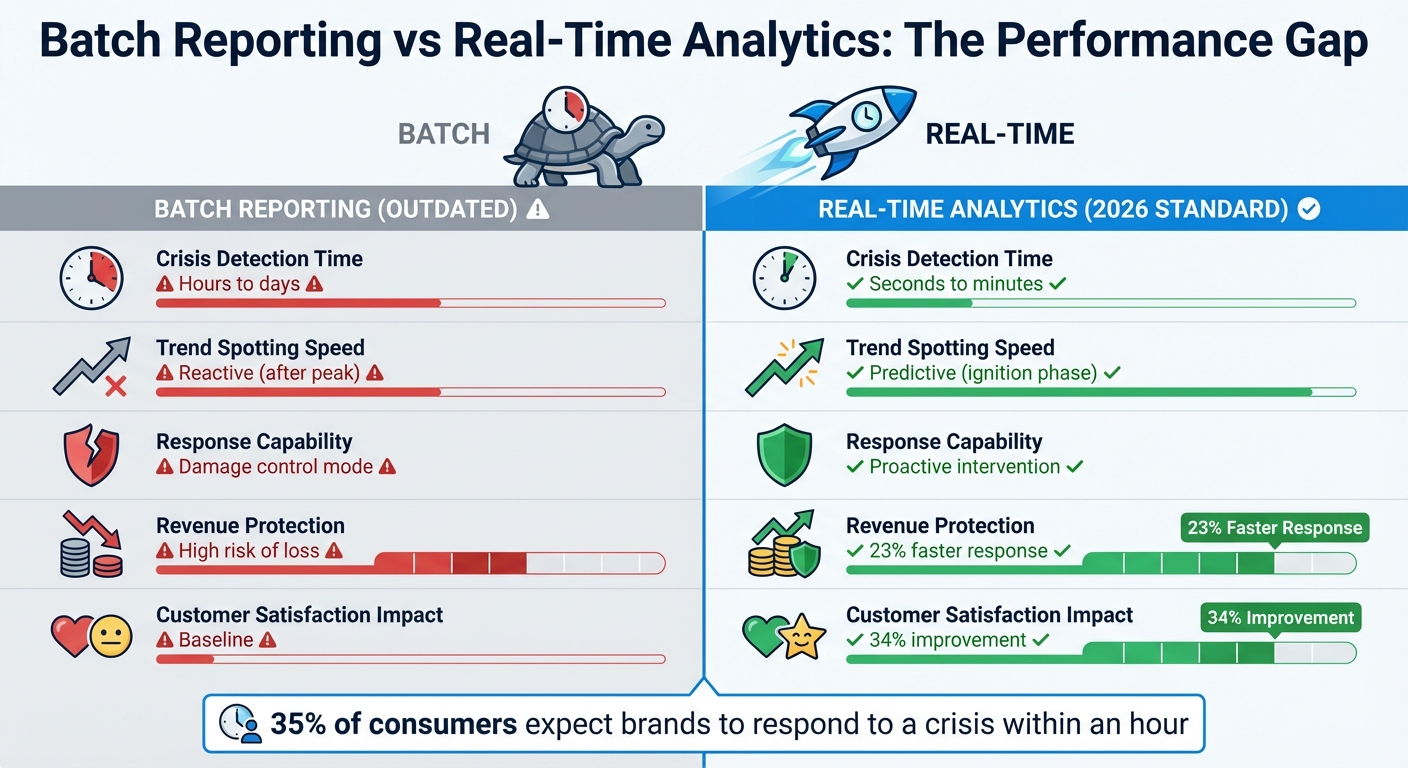
Real-Time vs Batch Reporting: Crisis Response Performance Comparison
Live Sentiment Scoring and Anomaly Detection
When it comes to avoiding a PR disaster, timing is everything. Real-time analytics can spot unusual patterns - like a surge in negative emojis or a sudden uptick in replies - and immediately alert your team to take action. We're talking minutes, not hours, to prevent small issues from spiraling into full-blown crises.
These tools go beyond basic keyword tracking. They monitor spikes in words like "lawsuit", "dangerous", or "boycott", while AI now picks up sarcasm and context. So, when someone tweets, "Great job breaking my trust", it’s flagged as criticism, not praise.
The stakes couldn't be higher. Take the example of a consumer electronics brand that caught wind of a product defect complaint spreading on Reddit and X. Thanks to real-time alerts, they issued a recall announcement within 45 minutes, stopping the story before it hit mainstream media. The quick action likely saved them from losing 30% in potential revenue. Compare that to traditional batch reporting, which might not have flagged the issue until the next day - long after the damage was done.
"The difference between organizations that survive reputational crises and those permanently damaged often comes down to one factor: how quickly they detected the problem and how rapidly they responded."
– Xpoz
Real-time tools also map influence, showing when high-profile accounts, like journalists or activists, interact with negative content about your brand. This matters because a single retweet from a prominent voice can push a complaint to 100,000 views in under an hour. Catching these early signals - like subtle sentiment changes or isolated complaints - gives you the chance to act before the narrative hardens.
And it’s not just about speed; it’s about staying ahead of the curve. The following table highlights how real-time analytics stack up against traditional batch reporting.
Performance Comparison: Batch vs. Real-Time
The difference between batch reporting and real-time analytics isn't just a matter of speed - it’s about staying in control. Batch reporting relies on pre-scheduled summaries, which only show what’s already happened. Real-time analytics, on the other hand, provide a live feed of what’s unfolding, giving you the power to act before problems escalate.
| Metric | Batch Reporting | Real-Time Analytics | Source |
|---|---|---|---|
| Crisis Detection Time | Hours to days | Seconds to minutes | xpoz.com |
| Trend Spotting Speed | Reactive (after peak) | Predictive (ignition phase) | blaze.ai |
| Response Capability | Damage control mode | Proactive intervention | xpoz.com |
| Revenue Protection | High risk of loss | 23% faster response | blaze.ai |
| Customer Satisfaction Impact | Baseline | 34% improvement | blaze.ai |
Here’s the kicker: 35% of consumers expect brands to respond to a crisis within an hour. With batch reporting, that’s almost impossible. By the time your team sees the issue, the conversation may already be viral. Real-time systems let you act while public perception is still forming, keeping the story from snowballing. Brands using these tools report a 23% faster response time and a 34% boost in customer satisfaction. It’s proof that speed isn’t just nice to have - it’s a game-changer for staying competitive and protecting revenue in 2026.
sbb-itb-b3cfc51
Top 7 Real-Time Social Media Analytics Tools for 2026
Platform Reviews
Sprinklr holds a top spot for enterprise teams, offering an impressive 94% sentiment accuracy while handling a staggering 5 billion social conversations daily. Its AI-driven response suggestions keep teams quick on their feet, but the starting price - $50,000+ annually - makes it a better fit for large-scale brands managing global campaigns where precision is non-negotiable.
Hootsuite Enterprise refreshes its real-time streams every 2–3 seconds, making it one of the fastest tools for live monitoring. With seamless Salesforce integration, it’s a go-to for sales-oriented teams. However, its sentiment analysis struggles with non-English content, which could be a drawback for global agencies. Still, it’s a strong choice for teams handling multiple client accounts that demand speed and streamlined workflows.
Brandwatch brings 15 years of historical data to the table and includes image recognition that can identify your logo in user-generated content. At $800/month, it’s a mid-market option that delivers rich contextual insights, tracking over 100 million sources and providing real-time alerts. It’s especially valuable for brands that need deep-dive analytics without breaking the bank.
Meltwater blends social listening with influencer tracking, offering a unified dashboard that combines social media and traditional media monitoring. Tailored for PR and marketing teams, it’s a versatile tool for those who need to keep tabs on both digital and conventional channels. Pricing is customized, making it accessible for enterprise-level needs.
Talkwalker Analytics earns high marks for its image recognition and ability to monitor both social and traditional media, reflected in its 4.5/5 customer satisfaction rating. It’s ideal for brands seeking thorough media coverage, from visual brand mentions to news outlet tracking. However, the lack of built-in publishing tools might be a drawback for teams looking for an all-in-one solution.
Mention is perfect for solopreneurs and small teams, offering alerts with an average response time of 30 seconds. Affordable at $49/month, it’s great for quick notifications, though its two-year cap on historical data might limit its usefulness for long-term trend analysis.
NetBase Quid uses Generative AI for market intelligence and excels at influencer rankings, earning a 4.1/5 satisfaction score. It’s tailored for enterprises focused on competitive intelligence and trend forecasting. While it delivers strong strategic insights, its limited integration with other social management tools could be a sticking point for some teams.
The right tool depends on your team’s size, budget, and specific needs. The table below breaks down the key features to help you make a quick comparison.
Feature Comparison Table
| Tool | Response Speed | Key Platforms | Analysis Depth | Starting Price | Alert Accuracy |
|---|---|---|---|---|---|
| Sprinklr | Real-time | All major platforms | Deep AI insights | $50,000+/year | 94% sentiment accuracy |
| Hootsuite Enterprise | 2–3 seconds | FB, IG, X, LinkedIn, YT | Workflow-focused | Mid-market pricing | High (drops for non-English) |
| Brandwatch | Real-time | 100M+ sources | 15-year historical data | $800/month | High with image recognition |
| Meltwater | Real-time | Social + traditional media | Influencer + media tracking | Custom quote | High for PR monitoring |
| Talkwalker Analytics | Real-time | Social + news outlets | Visual + media analysis | Custom quote | 4.5/5 satisfaction |
| Mention | 30 seconds | Web, X, FB, IG | 2-year historical limit | $49/month | Fast, focused alerts |
| NetBase Quid | Real-time | Major social platforms | Strategic AI insights | Custom quote | 4.1/5 satisfaction |
5-Step Setup Guide for Real-Time Monitoring
Implementation Steps
Getting real-time social media analytics up and running doesn't have to feel like rocket science. Here's a clear, practical guide to get you started.
Step 1: Connect your social accounts using official APIs.
Plugging in X, Instagram, Facebook, TikTok, and LinkedIn through their official APIs ensures you're getting data in near real-time - think under 60 seconds. Avoid shady scraping methods that lag and might even violate terms of service. For teams managing multiple accounts, enterprise tools make it easy to handle everything from one place.
Step 2: Set smart alerts based on your brand's baseline.
Don’t drown in notifications. Instead of flagging every mention, figure out what your "normal" activity looks like and set alerts for meaningful changes. For instance, trigger alerts when mention volume jumps 50% above your average or when keywords like your brand name paired with "lawsuit" or "dangerous" pop up. To keep it actionable, route these alerts directly into tools your team already uses, like Slack, WhatsApp, or your CRM.
Step 3: Prioritize velocity over volume in your dashboards.
Forget raw numbers - how fast mentions spike tells you way more. For example, if you usually see 50 mentions an hour and suddenly hit 200 in 10 minutes, that’s a red flag. Use Boolean searches to cut through the noise. Queries like ("BrandName") AND ("unsafe" OR "defect") help surface only the high-priority mentions.
Step 4: Test your system before going live.
Run simulations to make sure your alerts and response plans actually work. Test scenarios like a product safety issue or employee controversy to see if your system catches the spikes and routes them correctly. Set up tiered response protocols - basic monitoring for routine mentions, internal alerts for unusual activity, and all-hands-on-deck for major crises.
Step 5: Expand beyond social platforms.
Social media is just one piece of the puzzle. Track news sites, blogs, Reddit, and Quora to see how stories spread. If a complaint jumps from X to Reddit, it’s likely gaining traction and could go mainstream. Aggregating data from multiple platforms keeps you ahead of the narrative.
Common Mistakes to Avoid
Even the best systems can falter if you don’t avoid these pitfalls:
Mistake 1: Setting poor alert thresholds.
Too many alerts? Your team gets overwhelmed. Too few? You miss a brewing crisis. Start with conservative settings - like triggering alerts only for a 50% spike above your baseline - and tweak them based on your team’s capacity.
Mistake 2: Ignoring context in sentiment analysis.
Automated tools can miss sarcasm or community-specific slang. In streetwear, "sick" is a compliment, but in healthcare, it’s not. Modern NLP models handle this better, but you should still manually review a chunk of sentiment data - say, 20% - every month to catch errors.
Mistake 3: Monitoring platforms in isolation.
A complaint on X that migrates to Reddit or Instagram is escalating. If your system only tracks one platform, you’re missing the bigger picture. Cross-platform monitoring is essential.
"24-hour response times were acceptable in 2020, not 2026. If you can't respond quickly, don't monitor in real-time." - Alan Cassinelli, Marketing Manager, Blaze.ai
Mistake 4: Letting response delays ruin everything.
Real-time monitoring is pointless if your team takes hours to act. Build pre-approved templates and decision trees so you can respond within 15–60 minutes of spotting an issue. With nearly half of users expecting a reply within an hour, speed isn't optional.
Finally, don’t rely solely on automation. AI can misread tone or context, especially for high-stakes posts involving journalists, verified accounts, or viral content. Always have a human double-check responses before they go live.
Measuring Results and Calculating ROI
Case Studies
Real-time analytics are proving to be game-changers for businesses across industries. Let’s look at how three organizations turned insights into action - and savings.
A digital marketing agency took a bold step in 2025 by ditching five separate social listening tools in favor of the PandorLabs Social Media Data API. The result? They slashed data latency to under 60 seconds and pocketed $3,000 in monthly savings on subscriptions.
"We replaced 5 social listening tools with PandorLabs. Now we get better data, faster - and save $3K/month on tool subscriptions."
– Leading Digital Marketing Firm
Meanwhile, Global66, a fintech company, tapped into hidden opportunities using Brand24's real-time monitoring. María Camila Segura Matiz, the Head of Strategic Communications, shared how they uncovered unexpected brand ambassadors:
"Brand24 led us to discover many brand ambassadors we weren't even aware of. Interestingly, some ambassadors who shared their links with their followers eventually became influencers for us."
– María Camila Segura Matiz, Global66
This proactive approach didn’t just boost engagement - it empowered Global66 to tackle crises early and join important conversations before they spiraled.
These examples highlight how real-time analytics can deliver measurable, bottom-line benefits. But what do the numbers really look like?
ROI Calculator
To put it plainly, real-time analytics can save time, cut costs, and streamline operations. Here’s a snapshot of how the numbers stack up:
| Your Current Metrics | Baseline (Manual/Batch) | With Real-Time Analytics | Estimated Impact |
|---|---|---|---|
| Average Response Time | 4–24 hours | Under 15 minutes | 93%+ faster response |
| Manual Review Hours/Week | 20+ hours | 3 hours | 85% labor reduction |
| Tool Subscription Costs/Month | $3,000+ (multiple tools) | $500–$1,000 (unified platform) | $2,000+ saved monthly |
| Crisis Detection Speed | 1–6 hours | Under 60 seconds | Prevents viral spread |
| Customer Satisfaction Score | Baseline | +34% improvement | Higher retention |
Let’s break it down further: if your team spends 20 hours a week on manual reviews at $50/hour, that adds up to $52,000 annually. Switching to real-time AI could cut review time to just 3 hours weekly, saving roughly $44,000 per year. Add in tool consolidation savings of $24,000 annually, and you’re looking at a total of $68,000 in yearly savings.
And that’s before factoring in the revenue you protect by catching PR crises early. Spotting a brewing issue in under 60 seconds (the "Ignition Phase") versus six hours later (the "Mainstream Breakout") could be the difference between a quiet fix and a multi-million dollar reputational disaster.
Conclusion
By 2026, real-time social media analytics have shifted from a luxury to a necessity. The speed of online conversations has skyrocketed - what used to take hours to gain traction now unfolds in mere minutes. Customers demand responses in under 15 minutes, while misinformation races ahead, spreading 6x faster than corrections. If you’re still relying on outdated, hourly batch reports, you’re already playing catch-up.
The tools we've covered - ranging from affordable options like Awario ($29/month) to enterprise-grade solutions like Talkwalker and NetBase Quid - deliver lightning-fast updates with sub-60-second latency, AI-driven sentiment analysis boasting 99.7% accuracy, and instant alerts sent straight to your favorite messaging apps. Whether you’re a solo creator monitoring niche Reddit threads with KWatch.io or an agency juggling multiple clients through LenX, these platforms can slash manual review time by 85% and optimize workflows to save both time and effort.
Start with the 5-step process outlined earlier: link your accounts, set up sentiment-triggered alerts, customize dashboards, run live tests, and scale up. Establishing a behavioral baseline ensures your system catches critical anomalies instead of irrelevant noise. A tiered response strategy is key - your team should know exactly when to monitor, escalate, or act. These strategies not only simplify operations but also deliver measurable results, as seen in faster crisis management and happier customers.
The numbers don’t lie. Brands leveraging real-time monitoring report 23% quicker crisis response times and 34% higher customer satisfaction rates. Acting during the ignition phase - before a crisis goes viral - can save millions. That’s the kind of impact these tools can have on your reputation and your bottom line.
Don’t wait for the next viral storm to hit. Pick a platform, set your first alert, and turn real-time insights into real-world results. Staying ahead in today’s fast-paced digital landscape isn’t just smart - it’s essential for protecting your brand and driving growth.