In 2026, AI social listening tools are changing the game for brands. They’re spotting crises 35% faster, cutting response times by 43%, and capturing 2.3x more customer complaints before they escalate. These tools don’t just track mentions - they predict trends, decode emotions, and give brands a head start in the digital race.
Here’s the deal: AI-powered platforms like Brandwatch, Brand24, and Social Sonar are monitoring millions of sources, from TikTok to Reddit, while offering features like emotion detection, visual recognition, and predictive analytics. Whether you're running a solo hustle or managing a global brand, these tools help you stay ahead by turning online chatter into actionable insights.
Quick Picks:
- Best for Enterprises: Brandwatch (deep analysis, historical data, $800/mo+)
- Affordable Starter: Awario ($29/mo, real-time alerts)
- Agency Favorite: Brand24 (AI Brand Assistant, $199/mo)
Bottom line? AI social listening tools are the secret weapon for faster crisis management, smarter strategies, and spotting trends before they explode. Ready to level up your brand game?
What Are AI Social Listening Tools?
Definition and Development
AI social listening tools are cutting-edge platforms that harness artificial intelligence, natural language processing (NLP), and machine learning to monitor and decode online chatter from social media, blogs, forums, review sites, and even news outlets. Unlike the older, clunky systems that stuck to rigid keyword matching, these tools now grasp context, intent, and emotion - yes, even sarcasm and subtle cultural nuances.
Back in the day, these tools were limited to simple keyword alerts. Fast forward to today, and they’ve leveled up to multimodal analysis, where they can sift through text, images, videos, and audio. This means they don’t just catch tagged mentions but also spot products in videos or photos where no text reference exists. This evolution has been a game-changer for brands, letting them sniff out crises early and boost engagement metrics in ways that directly impact their bottom line.
"The technology existed to push content out, but the tools to pull insights in were outdated, expensive or shallow. We set out to build a platform to find the signal in this chaotic world of social media with AI." - Social Sonar Founders
How These Tools Work
These platforms are like digital bloodhounds, constantly scanning over 100 million sources - from mainstream social networks to obscure niche forums. The data they gather is then processed by AI, which categorizes mentions based on sentiment, emotion, and intent.
Here’s the magic: the system builds a behavioral baseline for your brand. So, if there’s a sudden surge in negative sentiment or a viral trend brewing, it flags it right away - giving you time to act before things spiral. Some tools even come with conversational AI assistants, where you can ask plain-English questions like, "What caused yesterday's spike in mentions?" and get instant, concise answers. And with 2026’s advancements, these tools are diving even deeper into predictive capabilities and nuanced analysis.
2026 Features
This year, AI social listening tools are flexing with features like emotion AI, visual recognition, and predictive analytics that take insights to the next level. Emotion AI doesn’t just label feedback as "positive" or "negative"; it can pinpoint feelings like admiration, anger, joy, or sadness. Imagine being able to tie emotional shifts directly to a campaign or product launch - powerful, right?
Then there’s visual recognition, which scans images and videos for logos, objects, scenes, and even demographic details. Think of all those Instagram or TikTok posts where your product shows up but isn’t tagged - that’s where this feature shines.
And let’s not forget predictive analytics. These tools can now forecast potential crises or viral trends before they explode, giving brands a crucial head start. Add in audio monitoring for podcasts and video content, and you’ve got a full-spectrum view of your brand’s digital health. These advancements mean faster reactions, smarter strategies, and the ability to seize opportunities before competitors even see them coming.
sbb-itb-b3cfc51
Best Social Listening Tools 2025: Brandwatch vs Meltwater vs Sprout Social vs Hootsuite vs Brand24
How AI Delivers Better Insights and Faster Response
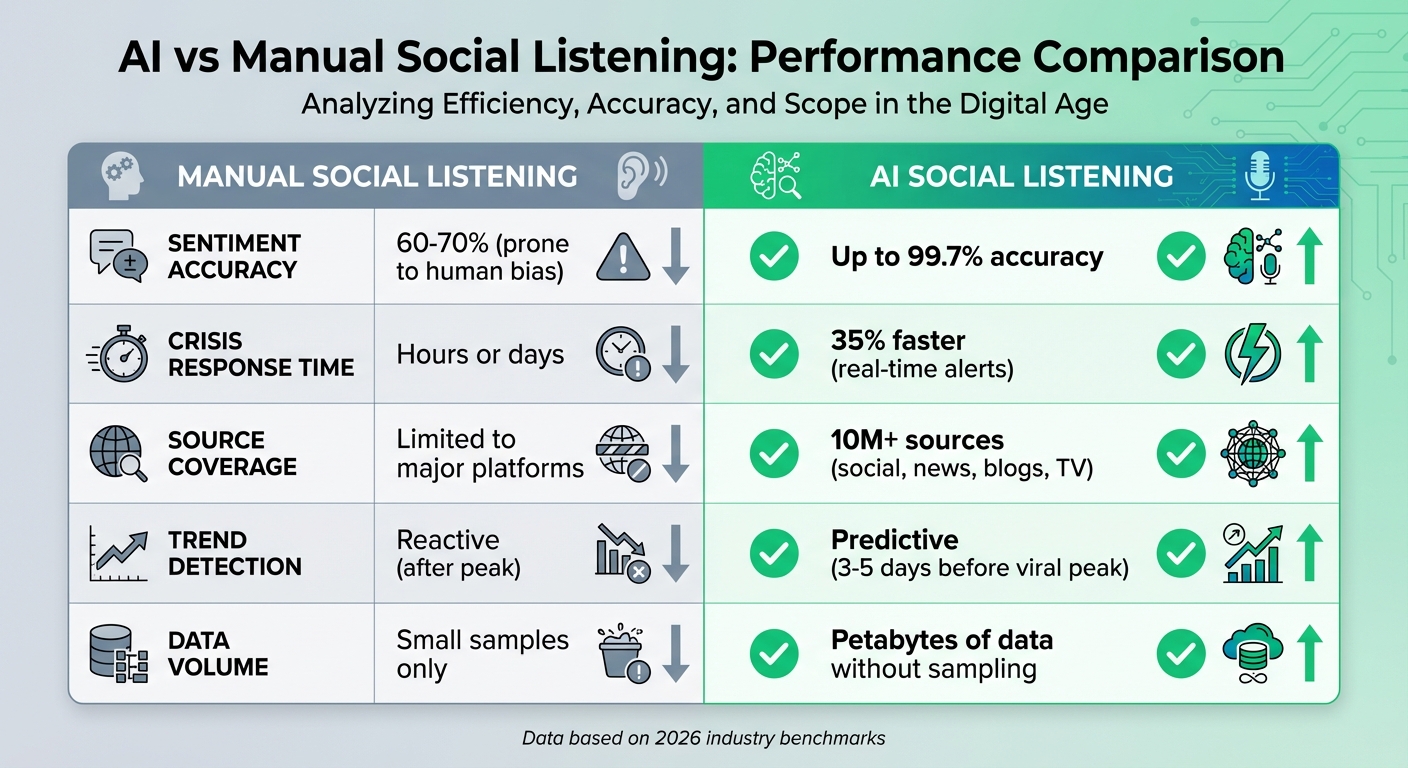
AI vs Manual Social Listening Performance Comparison 2026
AI isn't just quicker than manual methods - it’s smarter at pulling meaningful insights from the chaos of online chatter. Today’s AI-powered social listening platforms leverage transformer-based NLP to grasp context and subtlety, going beyond simple keyword matching. These tools can break down posts into detailed sentiment analyses, even distinguishing between sentiments about different brands or features in a single comment. Say goodbye to those vague “mixed” labels of the past.
What’s more, these platforms handle the tricky stuff - sarcasm, slang, and industry jargon. For example, a model trained to recognize that “heartbreak” is a compliment when describing an ice cream flavor avoids misclassifying it as negative feedback. This kind of precision is why AI sentiment models can hit accuracy rates as high as 99.7%, leaving manual methods (with their 60–70% accuracy) in the dust. By processing language so deeply, AI enables brands to uncover hidden emotions and predict trends at lightning speed.
Sentiment and Emotion Detection
AI tools don’t stop at labeling feedback as “positive” or “negative.” They dig into emotion AI, identifying feelings like joy, frustration, or anger. Using aspect-based analysis, these tools can evaluate different parts of a single statement. For instance, if someone tweets, “Love the design, hate the price,” the AI can separate the positive sentiment about aesthetics from the negative sentiment about cost.
They also excel at catching sarcasm and irony - something that’s tripped up older systems for years. Brand24 sums it up best:
"Our AI 'definitely gets sarcasm.' Honestly, though, Artificial Intelligence helps you make sense of the data to save you time".
This matters more than you might think. Without this level of nuance, brands could misinterpret sarcastic praise as genuine approval or miss frustration buried in ironic comments. Kantar’s Dx Analytics practice proved this precision, showing 39% better accuracy in analyzing complex conversations compared to other top social listening platforms. With such precise insights, AI doesn’t just report on what’s happening - it helps brands stay ahead of the curve by spotting trends and anomalies before they blow up.
Trend Forecasting and Anomaly Detection
AI doesn’t just track what’s trending - it predicts what will trend. By analyzing how fast conversations are growing and mapping participant networks, these tools can identify which niche topics are about to go mainstream. If there’s a sudden spike in mentions or a sharp shift in sentiment, automated anomaly detection kicks in with real-time alerts. Social Sonar captures this perfectly in their tagline:
"3 AM Crisis? You'll know by 3:01".
The results speak for themselves. Brands using these tools see 35% faster crisis response times and cut overall response times by 43%. Instead of reacting after a trend peaks, AI gives you a 3–5 day head start to prepare for viral moments. This shift from reactive to proactive monitoring is a game-changer for managing crises and staying relevant in fast-moving digital spaces.
Performance Comparison Table
| Metric | Manual Social Listening | AI Social Listening |
|---|---|---|
| Sentiment Accuracy | 60–70% (prone to human bias) | Up to 99.7% accuracy |
| Crisis Response Time | Hours or days | 35% faster (real-time alerts) |
| Source Coverage | Limited to major platforms | 10M+ sources (social, news, blogs, TV) |
| Trend Detection | Reactive (after peak) | Predictive (3–5 days before viral peak) |
| Data Volume | Small samples only | Petabytes of data without sampling |
The numbers don’t lie - AI social listening tools turn chaotic online chatter into actionable intelligence. They’re not just about monitoring; they’re about empowering brands to manage crises, engage customers, and outpace competitors with insights that matter.
Top 7 AI Social Listening Tools Ranked for 2026
Tool Rankings and Details
Here’s a rundown of the best tools for social media listening and monitoring, each offering a unique mix of features to help brands uncover insights and track trends in real time.
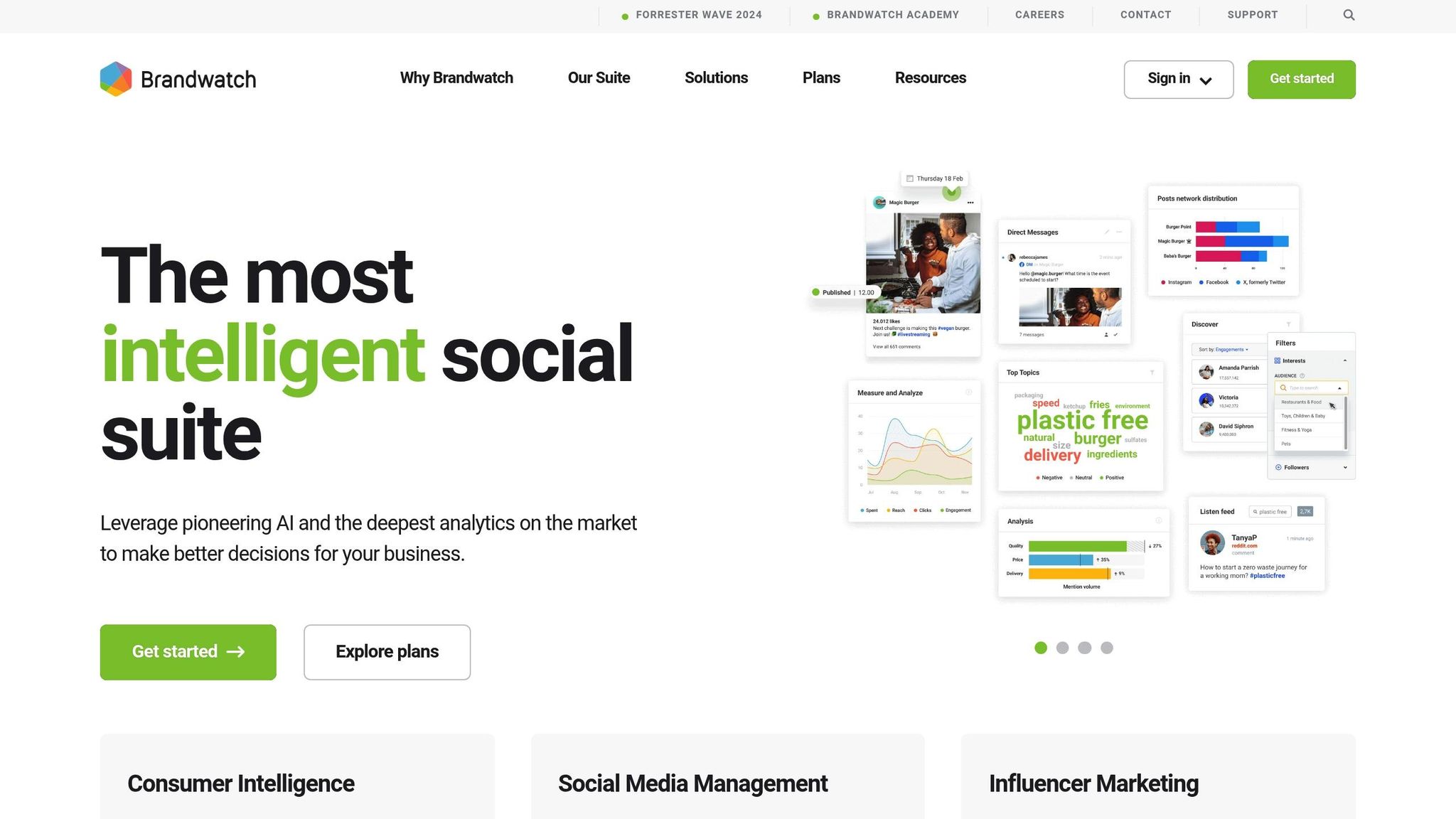
1. Brandwatch
Brandwatch stands out with its ability to dig deep into consumer behavior and trends. It boasts features like image recognition that identifies logos even when untagged, detailed demographic breakdowns (think gender, interests, and occupations), and a historical archive stretching back to 2010 for long-term analysis.
Pricing: SMB plans range from $800–$1,200/month; Mid-tier/Agency plans cost $2,000–$3,500/month; Enterprise starts at $5,000+/month (annual contracts).
Pros: API access for custom dashboards, over 10 years of historical data, and extensive demographic insights.
Cons: Pricey, with custom pricing that can be unclear, plus a learning curve for new users.
Best for: Large enterprises and agencies that need in-depth consumer data and trend analysis.
2. Brand24
Brand24 goes beyond basic sentiment analysis, detecting specific emotions like frustration, joy, or anger. Its Anomaly Detection feature explains sudden spikes in mentions, while the AI Brand Assistant acts like ChatGPT for your brand's data. It monitors over 25 million sources, including podcasts, newsletters, and even Telegram.
"Brand24 is the one stop shop for your brand insights. Now with even more AI-powered capabilities, it is one of the only tools you need to understand your brand health in minutes." - Sara Stella Lattanzio, B2B marketing leader
Pricing: Individual ($199/mo), Team ($299/mo), Pro ($399/mo), Business ($599/mo), Enterprise (starting at $1,499/mo).
Pros: Sarcasm detection, white-labeled reports for agencies, QuickShare links for easy client access, and an AI-driven Presence Score.
Cons: Mid-tier pricing can be a stretch for smaller budgets, and advanced features are locked behind higher-tier plans.
Best for: Agencies and mid-sized brands looking to track reputation with client-friendly reporting.
3. Talkwalker
Talkwalker blends AI-powered insights with visual listening, identifying competitor products in images even when no text is present. It also offers up to 24 months of historical data for trend tracking.
"Adopting the right social listening tool has allowed us to adapt proactively to digital transformation and continue to offer a valuable shopping experience." - Federica Palermini, Digital and Innovation Manager, Carrefour Italy
Pricing: Custom quotes based on three tiers: Listen, Analyze, and Business.
Pros: Advanced consumer intelligence, strong visual listening tools, and 24/7 support for complex sectors.
Cons: Custom pricing can feel opaque, and it’s heavily enterprise-focused, leaving limited options for smaller businesses.
Best for: Big players in banking, marketing, and consumer goods that need robust visual monitoring.
4. Sprout Social
Sprout Social combines social listening with content publishing and scheduling, all in one place. Its Smart Inbox gathers messages from multiple channels, while CRM integration helps track customer relationships over time.
"At Uber, we use social listening on a daily basis, which allows us to understand how our users feel about the changes we're implementing." - Krzysiek Radoszewski, Marketing Lead, Central & Eastern Europe @ Uber
Pricing: Standard ($199/user/mo), Professional ($299/user/mo), Advanced ($399/user/mo). Social listening is an add-on costing $3,000–$6,000/year.
Pros: Combines listening with engagement tools, CRM integration, and an easy-to-use interface.
Cons: Per-user pricing adds up fast, and the listening feature comes as an expensive add-on.
Best for: Social media managers who want a unified tool for listening, scheduling, and collaboration.
5. Meltwater
Meltwater bridges traditional media monitoring (TV, print, radio) with social intelligence, making it a favorite for PR and communications teams. Its GenAI Lens tracks how brands show up in AI-generated content like ChatGPT, while Crisis Mode sends alerts every 5 minutes during PR emergencies.
Pricing: Essentials ($6,000–$12,000/year), Suite ($15,000–$25,000/year), Enterprise ($40,000–$100,000+/year).
Pros: Covers both traditional and digital media, tracks influencers, and offers flexible crisis monitoring.
Cons: Requires a hefty annual commitment and has a complex interface for users focused only on social media.
Best for: PR and media teams that need a mix of traditional and digital coverage.
6. Hootsuite
Hootsuite provides an all-in-one platform for social media scheduling, publishing, and engagement monitoring. Its unified inbox simplifies message management, although its social listening features are more basic than specialized tools.
Pricing: Professional ($99/mo), Team ($249/mo), Enterprise (Custom).
Pros: Affordable starting point, built-in ad management, and a familiar interface for existing users.
Cons: Limited listening features compared to dedicated tools and restricted access to historical data.
Best for: Teams focused on content scheduling and management rather than deep analytics.
7. Awario
Awario is perfect for budget-conscious users, offering precise Boolean monitoring for just $29/month. It delivers real-time alerts and sentiment tracking, making it an affordable option for small businesses.
Pricing: Starter ($29/mo), Pro ($89/mo), Enterprise ($249/mo) billed annually.
Pros: Extremely affordable, precise Boolean search, and real-time monitoring.
Cons: Limited historical data, fewer advanced AI features, and basic reporting.
Best for: Startups and small businesses needing essential monitoring without breaking the bank.
Feature Comparison Table
Here’s a quick snapshot of the tools and their standout features to help you decide:
| Tool | Target Groups | Sentiment Accuracy | Platforms Supported | Alert Speed | Pricing (Starter) | Coverage Depth |
|---|---|---|---|---|---|---|
| Brandwatch | Enterprises, Agencies | Up to 95% | Social, news, blogs, forums | Real-time | ~$800/mo | 100M+ sources, historical archive since 2010 |
| Brand24 | Agencies, Mid-market | ~95% (sarcasm detection) | 25M sources (social, podcasts, newsletters) | Real-time with anomaly alerts | $199/mo | Extensive monitoring with emotion AI |
| Talkwalker | Enterprises | ~95% | Social, broadcast, news | Real-time | Custom pricing | Visual listening and up to 24 months of data |
| Sprout Social | Social Managers | ~90% | Major social platforms | Real-time | $199/user/mo + add-on | Unified inbox with CRM integration |
| Meltwater | PR Teams | ~90% | Social, TV, print, radio | 5-min crisis mode | ~$500/mo (avg.) | Covers traditional and digital media |
| Hootsuite | Social Managers | ~85% | Major social platforms | Real-time | $99/mo | Integrated scheduling and publishing |
| Awario | SMBs, Startups | ~80% | Social, blogs, forums | Real-time | $29/mo | Boolean search with basic sentiment analysis |
5-Step Implementation Guide
Getting started with AI social listening tools doesn’t have to be overwhelming. Here’s a step-by-step guide to take you from setup to actionable insights in less than a week.
Step 1: Define Keywords and Queries
Start by nailing down the areas you want to monitor. Your keyword list should focus on three key categories: brand health, competitive insights, and customer intent. For brand health, include your company name, product names, social handles, and even common misspellings. For competitive insights, track rival brand names and phrases like "alternative to [Competitor]" to uncover opportunities they might be missing. When it comes to customer intent, look for high-value searches like "best [product category]" or "recommendations for [specific need]" - these can lead you straight to potential buyers.
Want to dig deeper? Use Boolean logic for precision. For example, pair "Brand Name" AND "Problem" to weed out irrelevant mentions. Add exclusion rules to cut through the noise - filter out unrelated uses of your brand name entirely. Many platforms also let you enable features like sarcasm detection and emotion tracking (e.g., anger, joy, disgust) to better understand the sentiment behind the chatter. Once your keywords are ready, it’s time to connect your data sources.
Step 2: Connect Data Sources
Plug in your social media accounts - Facebook, LinkedIn, X (formerly Twitter) - using OAuth for accurate engagement tracking. For broader coverage, AI crawlers can monitor blogs, forums, news sites, and even podcasts based on your keywords. Tools like Brand24 scan over 25 million sources in real-time, while Social Sonar tracks mentions across 10 million platforms, including heavy hitters like CNN, BBC, and The New York Times. Setting up your first monitor? Most platforms make it quick and painless - some as fast as 60 seconds.
To stay on top of critical mentions, sync alerts with Slack or email so your team gets notified instantly. Advanced tools can even integrate first-party data, like customer service emails or chat logs, giving you a more complete picture of your brand’s online presence.
Step 3: Customize AI Models
Pre-built sentiment models are a good start, but they often miss the nuances of your industry. For example, terms like "breakup" or "heartbreak" might seem negative, but in the context of a Ben & Jerry’s campaign, they could actually signal positive engagement. That’s where custom training comes in. Use historical feedback to refine your AI models, ensuring they align with your brand’s unique tone.
Platforms like MonkeyLearn make it easy for non-tech users to train models, while more advanced tools like Brandwatch and Talkwalker offer features like sarcasm detection and entity-level sentiment analysis. Regularly compare automated results with human reviews to keep your models sharp. With proper customization, AI tools can analyze conversations with 39% greater accuracy than standard setups.
Step 4: Test Alerts and Dashboards
Set up real-time alerts to flag spikes in mentions, shifts in sentiment, or the use of crisis-related keywords. Establish behavioral baselines so the system can detect anomalies right away. Run test queries to ensure your dashboards display data clearly and consistently. Make sure your team has easy access to reports, and format them in a way that’s actionable. Features like QuickShare links and white-labeled reports can streamline how you share insights with stakeholders.
Once your alerts and dashboards are running smoothly, you’re ready to dive into the data and start refining your strategies.
Step 5: Analyze Trends and Adjust Strategies
With your tool up and running, conduct weekly reviews to spot emerging trends, customer pain points, and shifts in the competitive landscape. Pay attention to patterns in high-intent conversations - they can reveal product gaps before they become widespread. For instance, Logitech discovered through Reddit that webcam quality was a deciding factor for 68% of work-from-home buyers.
AI tools also give you a speed advantage. They can cut response times by 43%, letting you address issues faster and refine your approach in real-time. Don’t forget to revisit your keywords and exclusions monthly to ensure you’re keeping up with evolving conversations around your brand.
Results and Case Studies
The numbers don’t lie - AI social listening tools are delivering real, measurable wins for businesses of all sizes. These anonymized case studies highlight how different industries are leveraging AI to tackle unique challenges and drive results.
Agency Case Study
Picture this: A mid-sized digital marketing agency juggling 12 enterprise clients and monitoring brand mentions across a staggering 10 million sources. When they brought in AI-powered anomaly detection, the game changed. The tool flagged behavioral deviations - like a product recall rumor on X - within seconds, allowing the team to launch a coordinated response in just 90 seconds. That’s a 50% cut in crisis response time compared to their old-school manual methods. And it didn’t stop there. The AI also helped them identify 2.3x more customer complaints, preventing small issues from snowballing into PR disasters. These results didn’t just save time - they set a new standard for proactive brand management.
Brand Case Study
A consumer electronics brand took AI social listening to Reddit and niche forums to uncover what really drives purchases. The findings? Webcam quality was the deciding factor for 68% of work-from-home buyers. Armed with this insight, the brand revamped its messaging to spotlight webcam features across social platforms and blogs. The payoff? A 75% surge in organic web traffic in just three months, as users flocked to compare webcam options. On top of that, AI pinpointed regional delivery trends, letting the brand fine-tune its fulfillment strategies for maximum efficiency. These insights weren’t just a win for the brand - they laid the groundwork for individual creators to find success too.
Solopreneur Case Study
Even solo creators are cashing in on AI’s capabilities. Take one content creator who turned to AI emotion detection to fine-tune their personal brand consultancy. The tool revealed that tutorial content sparked the most admiration and joy among their audience. The result? A pivot to more educational posts that boosted engagement by 30% and slashed response times by 43%. Plus, with AI-generated digests cutting down manual analysis time, this creator could focus more on creating - and less on crunching data.
Metrics Summary Table
| Input Metric | Baseline (Manual) | AI-Powered Output |
|---|---|---|
| Crisis Response Time | 4–6 hours | 90 seconds–2 hours |
| Complaint Detection Rate | 100 issues/month | 230 issues/month |
| Engagement Rate | 2.1% | 2.7% |
| Traffic from Insights | 5,000 visits/month | 8,750 visits/month |
| Manual Analysis Time | 15 hours/week | 2 hours/week |
These case studies and metrics paint a clear picture: AI isn’t just a tool - it’s a competitive edge that’s reshaping how businesses and creators connect with their audiences.
Wrapping It Up
AI social listening tools have come a long way, shifting from simple keyword trackers to advanced systems that grasp context, detect emotions, and even predict potential crises. By 2026, these tools are delivering real results: 43% faster response times and 2.3x more customer complaints captured from over 25 million sources in real time.
The leap from manual monitoring to AI-powered platforms means you’re no longer drowning in endless data streams. Today’s tools use conversational AI to answer your questions in plain English, create automated reports, and instantly flag unusual activity. This evolution isn’t just about saving time - it’s about spotting trends early and turning insights into revenue.
"For someone like me, who doesn't want to read every single mention, this AI assistant clearly explains what's happening on social media about my brand, without the manual work." – Nishant Sahay, Marketing Lead
These tools don’t just simplify your day-to-day - they’re built for immediate results. Most platforms offer free trials or even forever-free plans, with paid options starting at just $29/month. Setup is ridiculously fast - plug in your keywords, connect your platforms, and let AI do the heavy lifting in under two minutes.
The real question isn’t if you’ll adopt AI social listening - it’s how quickly you’ll make it part of your strategy. Check out the rankings above or head over to TopSocialTools.com for even more tailored solutions to supercharge your social media game.
Related Blog Posts
- The Topsocialtools Guide to Social Media Listening Tools in 2025
- How AI-Powered Social Media Monitoring Tools Detect Micro-Trends Before They Go Viral
- Uncovering Hidden Insights with Next-Gen Social Media Monitoring Tools
- Ultimate Guide to Real-Time Social Media Analytics in 2026: Tools, Metrics, Strategies & Live Dashboards