Ready to stop wasting cash on influencer guesswork? Here’s the deal: influencer marketing is a $24 billion juggernaut in 2026, but 62% of brands still can’t prove ROI. That’s millions burned on partnerships with no clue what’s coming back. The fix? ROI tools that track every dollar spent and earned.
These platforms ditch vanity metrics (likes, followers) for real revenue drivers like Average Order Value (AOV), Customer Lifetime Value (CLV), and multi-touch attribution. Brands using them report 3.5x better ROI - and some rake in $20 for every $1 spent. Tools like Upfluence, Grin, and Aspire integrate with Shopify, sniff out fake followers (saving 30–40% of budgets), and automate FTC compliance.
Quick Takeaways:
- Fake follower detection: Up to 90% accuracy saves brands from wasting cash.
- Multi-touch attribution: Tracks the full customer journey, not just the last click.
- Top ROI tools: Aspire ($5,000+/month), Grin ($500/month), Upfluence ($400/month) - each built for different needs like e-commerce or agency management.
Bottom line? If you’re still tracking campaigns in spreadsheets, you’re leaving money on the table. These tools turn influencer marketing into a measurable revenue engine. Let’s break down the best ones and how they stack up.
Why ROI-Focused Influencer Tools Matter in 2026
How Influencer Marketing Metrics Changed
82% of brands now prioritize ROI tracking over follower counts. This marks a major shift from chasing vanity metrics to focusing on revenue-driven strategies. Today’s influencer tools have come a long way from basic API dashboards. They now act as decision-making powerhouses, tying influencer performance directly to business results like Cost Per Acquisition (CPA) and Customer Lifetime Value (CLV). Plus, automated platforms are cutting manual work by up to 90%, while improving ROI visibility by 40–50%.
| Timeline | Primary Focus | Key Challenge |
|---|---|---|
| 2018–2020 | Follower counts, likes | No link to revenue |
| 2021–2023 | Engagement rates, reach | Manual tracking, limited attribution |
| 2024–2026 | Conversions, CLV, multi-touch attribution | Fraud detection, compliance monitoring |
One game-changer? Multi-touch attribution. Unlike outdated "last-click" models that credit only the final step before a purchase, 2026 tools map the entire customer journey. They give credit to influencers who spark initial interest, even if the sale happens days later. This is especially critical for B2B brands with longer sales cycles, where early influencer-driven awareness often leads to sales further down the line.
The evolution of these tools has redefined the metrics that matter, shifting the focus squarely onto outcomes that impact revenue.
Core Metrics Every ROI Tool Should Track
Modern tools don’t just count likes and comments - they measure actual revenue impact. While engagement rate (calculated as (likes + comments + shares + saves) ÷ total reach × 100) is still a key metric, it’s now paired with fraud detection. Tools flag creators with engagement rates over 10%, as this often signals bot activity. For context, authentic engagement typically falls between 2–5% on Instagram, so anything higher deserves a closer look.
Fake follower detection is another must-have. Advanced platforms now analyze over 200 data points - like follower growth trends, comment authenticity, and audience location - to spot fake engagement with over 90% accuracy. For instance, if a creator’s audience is concentrated in regions outside your target market, it’s a red flag.
Earned Media Value (EMV) remains a trusted metric, with 83% of brands viewing it as a reliable ROI indicator. But EMV is now complemented by Return on Creator Spend (ROCS), which treats influencers like a performance channel, similar to paid search. Additionally, brands track Cost-per-engaged-audience (CPEA) to gauge how efficiently their spend drives real interactions. For e-commerce, metrics like Average Order Value (AOV) and Customer Lifetime Value (CLV) are essential to determine whether influencer-driven customers are profitable over time.
Compliance tracking has also stepped up. Automated dashboards now flag missing FTC disclosures (e.g., #ad) and ensure adherence to GDPR and the EU’s Digital Services Act. It’s not just about avoiding fines - transparency is key to maintaining trust in today’s market.
What’s New in 2026
The latest tools are tackling the flaws of older systems head-on. AI-driven authenticity checks are now the norm, with platforms like HypeAuditor and Brandwatch analyzing unusual follower spikes, automated engagement patterns, and audience authenticity with up to 98% accuracy. These features not only catch fraud but also predict campaign performance, helping brands avoid underperforming partnerships.
Performance-based pay is also shaking things up. 53% of brands now use performance-driven compensation models, which require tools that can track conversions and revenue per creator accurately. Interestingly, gifted partnerships often see better engagement (2.19%) compared to paid posts (1.94%). AI agents like Uplodio’s "Amy" or Grin’s "Gia" are helping brands automate influencer discovery and outreach, achieving reply rates of 30%, far above the manual average of 5%.
Real-time attribution for short-lived content is another breakthrough. Dashboards now update within 15 minutes - essential for tracking fast-moving viral content and TikTok Shop promotions. With TikTok Shop adoption nearly doubling year-over-year and 32% of brands already selling on the platform, this capability is a must. Seamless integrations with CRMs like Salesforce and HubSpot, as well as e-commerce platforms like Shopify, let brands follow the customer journey from influencer post to purchase.
"Why settle for vanity metrics when you can connect influence directly to measurable growth? With Upfluence, don't just track creator content; turn it into business intelligence." - Upfluence
The takeaway? 74% of marketers plan to increase their influencer marketing budgets in 2026. But only those leveraging ROI-focused tools - complete with AI fraud detection, multi-touch attribution, and real-time tracking - will turn influencer marketing into a dependable revenue engine.
How to Measure Influencer Marketing ROI (5-Step Guide + Formula Explained)
Top 8 Influencer Marketing Tools Reviewed
Picking the right influencer marketing tool can completely change the game. It's not just about tracking likes or shares anymore - it's about connecting every dollar spent to actual results. Here's a breakdown of some top tools, complete with pricing, features, and who they're best for.
Upfluence
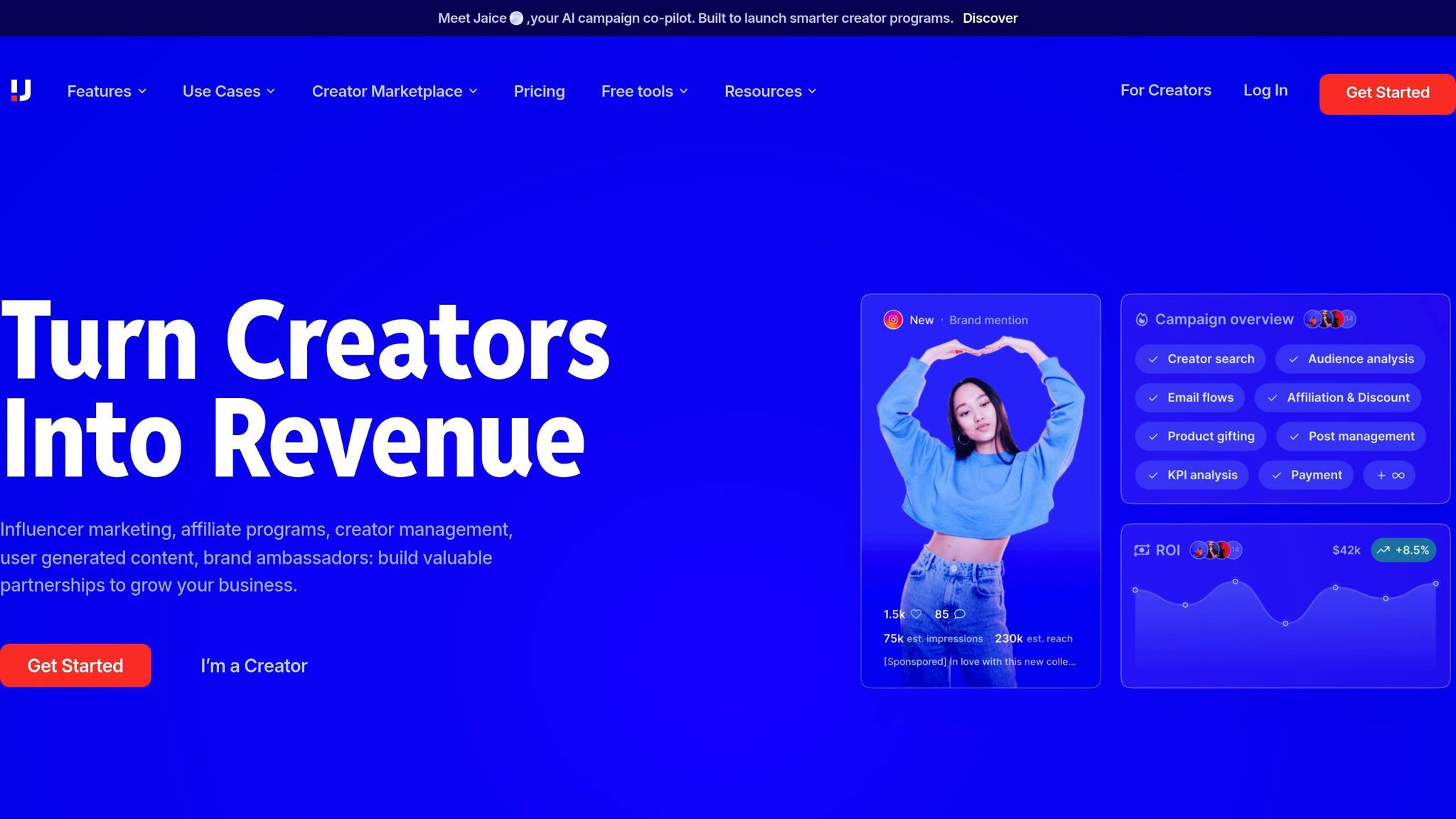
Upfluence is all about turning influencer campaigns into cold, hard numbers. With seamless Shopify and Amazon integrations, it tracks sales, Average Order Value (AOV), and Customer Lifetime Value (CLV) for each creator. If you're in the e-commerce world or managing multiple storefronts, this tool helps you connect influencer efforts directly to your revenue stream.
Its Chrome extension is a time-saver, letting you evaluate creators on platforms like Instagram or TikTok without leaving your browser. From engagement rates to audience demographics, it simplifies the vetting process.
Key Features:
- Revenue Tracking: Links influencer posts to Shopify/Amazon sales, tracking AOV and CLV per creator.
- AI-Powered Discovery: Vet creators instantly with a Chrome extension across Instagram, TikTok, and YouTube.
- Custom Tracking: Assigns unique promo codes, affiliate links, and UTM parameters.
- All-In-One Management: Handles outreach, contracts, product seeding, and payments on a single dashboard.
| Pricing Tier | Monthly Cost | What's Included |
|---|---|---|
| Starter | $478+ | Basic discovery, 1 user, Shopify integration |
| Growth | $800+ | Multi-user access, Amazon tracking, automated workflows |
| Enterprise | Custom | White-label reports, dedicated account manager, API access |
Pros:
- Perfect for e-commerce brands with Shopify or Amazon setups.
- Chrome extension speeds up creator discovery by 70%.
- Tracks the entire journey from post to purchase.
Cons:
- Starting at $478/month, it's pricey for smaller budgets.
- Steep learning curve for those new to attribution models.
- Demo-only trial - no free version.
Who It's For: E-commerce brands and agencies focused on tracking ROI down to the product level. If you want to know exactly which influencers are driving profitable sales, Upfluence is a solid choice.
Full review: Upfluence
Traackr
Traackr approaches influencer marketing as a relationship game rather than a simple transaction. Designed for enterprise brands and PR agencies, it focuses on long-term partnerships instead of one-off campaigns. It keeps tabs on every interaction - emails, contracts, past performance - so your team always has the full picture.
Its standout feature? Competitive benchmarking. Traackr compares your influencer metrics against industry standards, making it easier to spot underperforming campaigns and shift resources to what’s working.
Key Features:
- Relationship Management: Tracks every creator interaction, contract, and payment like a CRM.
- Benchmarking: Compares your Earned Media Value (EMV) and engagement rates to industry averages.
| Pricing Tier | Monthly Cost | What's Included |
|---|---|---|
| Professional | Custom | Relationship tracking, basic benchmarking, 5 users |
| Enterprise | Custom | Advanced analytics, API access, unlimited users |
| Agency | Custom | White-label reports, multi-client management |
Pros:
- Exceptional for managing large-scale creator relationships.
- Benchmarking helps identify underperforming partnerships.
- Tailored for enterprise-level campaigns.
Cons:
- Pricing is steep and geared toward larger brands.
- Complex features require a dedicated team member.
- Not ideal for smaller campaigns or businesses.
Who It's For: Enterprise brands and PR agencies juggling 100+ creator relationships. If you're running long-term ambassador programs, Traackr provides the tools to manage them effectively.
Full review: Traackr
Brandwatch
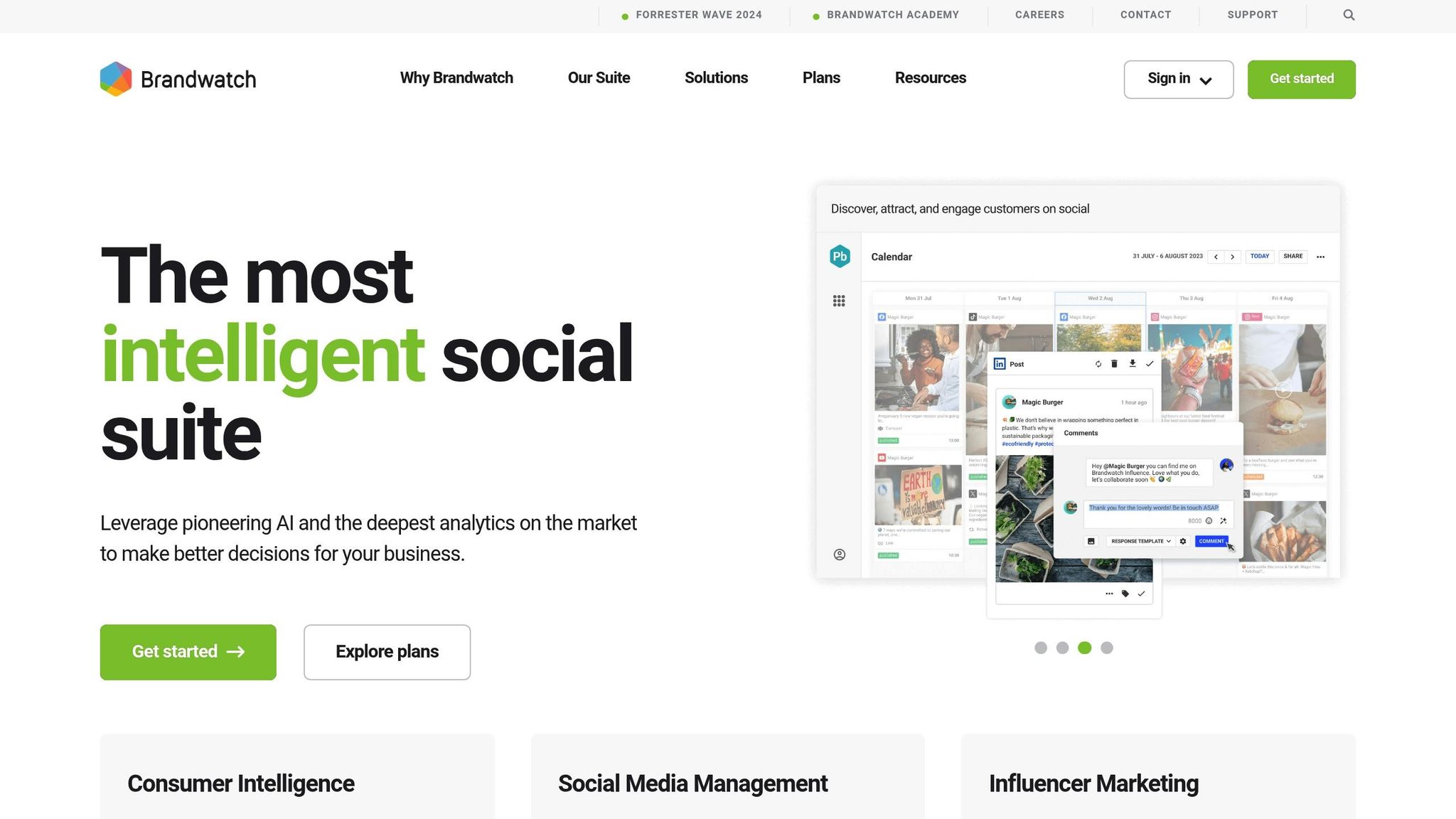
Brandwatch leans into AI to predict which influencers will deliver results before you spend a dime. By analyzing over 200 data points - like follower growth, engagement trends, and audience authenticity - it forecasts campaign outcomes with over 90% accuracy. For agencies managing multiple clients, this predictive power takes the guesswork out of influencer selection.
Real-time dashboards update every 15 minutes, making it ideal for fast-paced campaigns on TikTok or Instagram Reels. Spot sentiment changes, viral moments, or engagement drops as they happen, and adjust your strategy instantly.
Key Features:
- Predictive Analytics: AI forecasts campaign ROI based on creator history and audience quality.
- Sentiment Analysis: Tracks how audiences react to influencer content (positive, negative, neutral).
- Real-Time Dashboards: Updates every 15 minutes for dynamic campaign tracking.
- Fraud Detection: Identifies fake followers and bot activity with up to 92% accuracy.
| Pricing Tier | Monthly Cost | What's Included |
|---|---|---|
| Essentials | Custom | Basic analytics, 3 users, 10 campaigns/month |
| Advanced | Custom | Predictive analytics, sentiment tracking, 25 campaigns/month |
| Enterprise | Custom | White-label reports, API access, unlimited campaigns |
Pros:
- AI-powered insights reduce wasted spend on ineffective creators.
- Real-time tracking keeps you ahead of trends and sentiment shifts.
- Fraud detection safeguards your budget from fake engagement.
Cons:
- Custom pricing means no transparency upfront.
- Overkill for small or simple campaigns.
- Advanced features require some training to fully utilize.
Who It's For: Agencies or brands running high-volume campaigns across multiple clients. If you need to predict outcomes and manage several campaigns at once, Brandwatch’s AI-driven insights are a major asset.
Full review: Brandwatch
Aspire
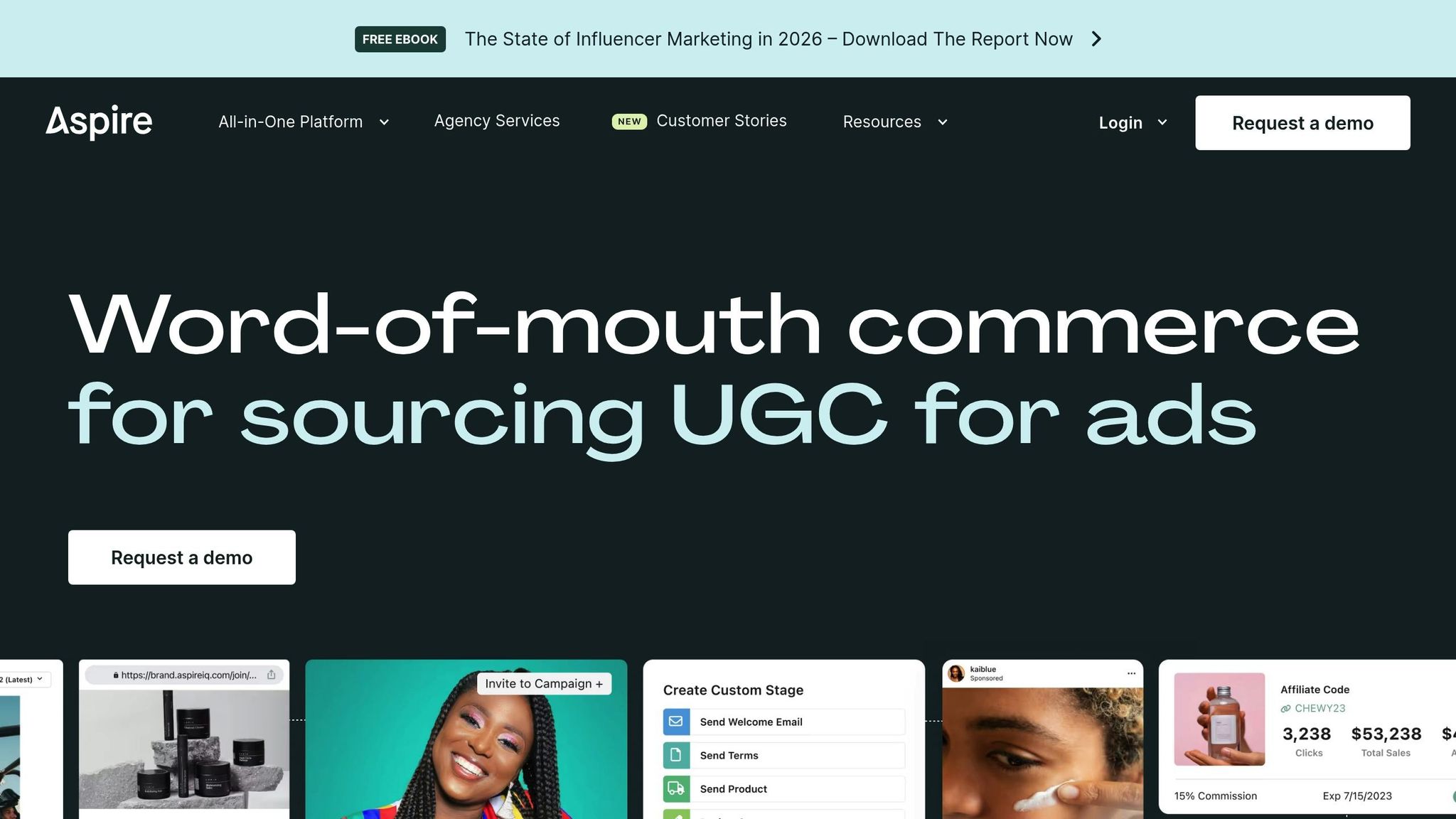
Aspire cuts down on the manual work involved in influencer marketing, letting you focus on strategy instead of logistics. Its standout feature, SecureCodes™, generates one-time promo codes to prevent leaks and ensure accurate tracking. This is a lifesaver for brands worried about creators sharing codes publicly or affiliates gaming the system.
Another highlight is its branded recruitment pages, which allow creators to apply directly to your campaigns. Forget chasing influencers through DMs - Aspire lets you streamline onboarding with custom portals.
Key Features:
- SecureCodes™: One-time promo codes ensure precise attribution and prevent fraud.
- Branded Recruitment Pages: Custom portals simplify creator applications.
- 4-Click ROI Tracking: Direct integration with Shopify/WooCommerce for sales tracking.
| Pricing Tier | Monthly Cost | What's Included |
|---|---|---|
| Growth | $5,000+ | Unlimited campaigns, 10 users, Shopify integration |
| Enterprise | Custom | White-label reports, API access, dedicated support |
Pros:
- SecureCodes™ lock down tracking and eliminate fraud risks.
- Recruitment pages make it easier to onboard creators.
- Built for long-term ambassador programs.
Cons:
- Starting price of $5,000/month targets enterprise budgets.
- Not ideal for one-off campaigns.
- Requires a commitment to long-term influencer relationships.
Who It's For: Brands managing 50+ creators and focusing on long-term ambassador programs. Aspire automates the heavy lifting, from onboarding to tracking.
Full review: Aspire
sbb-itb-b3cfc51
Side-by-Side Comparison Tables
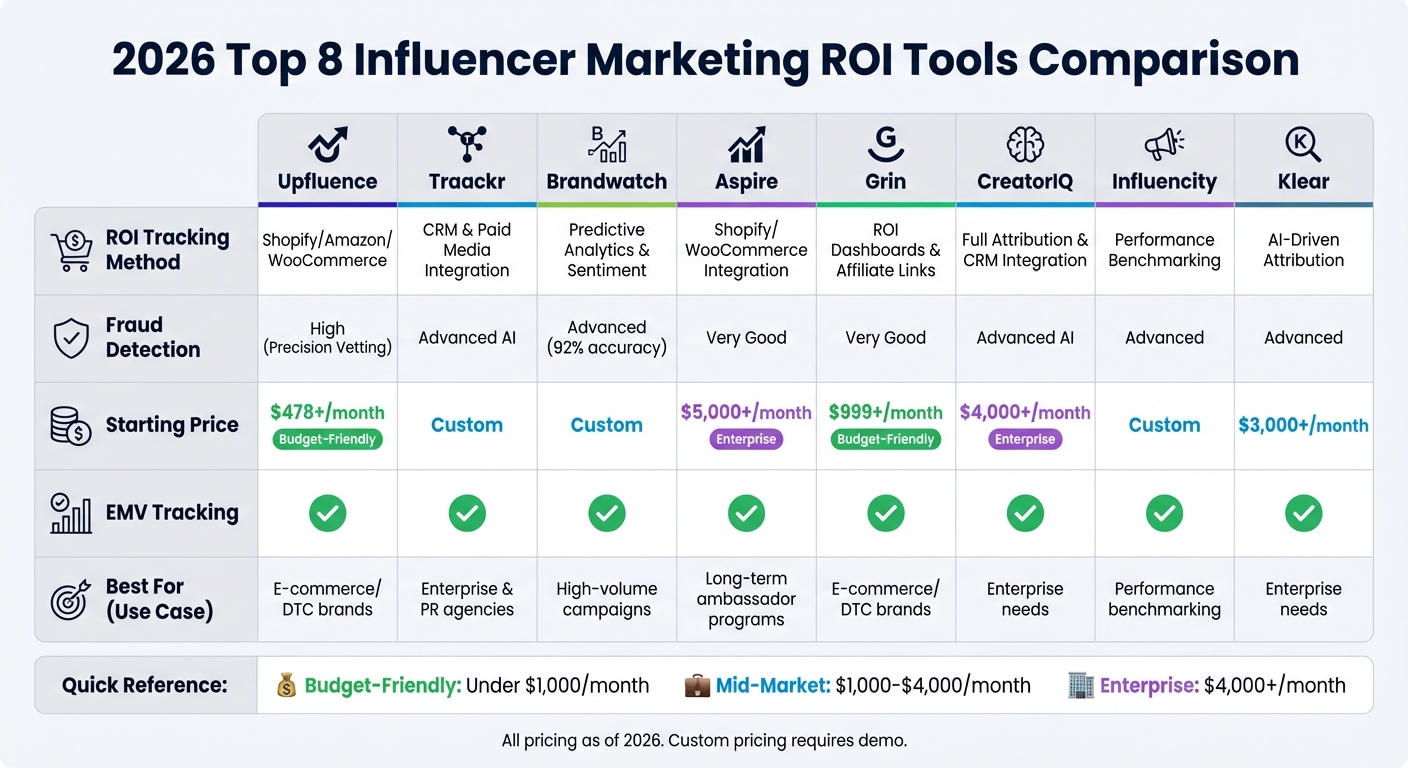
Top 8 Influencer Marketing ROI Tools Comparison 2026: Features, Pricing & Best Use Cases
Let’s cut through the noise - these tables break down the top influencer marketing tools to help you zero in on the best fit for your campaigns. Whether you’re chasing direct sales, fraud detection, or enterprise-level solutions, here’s the data you need to make a confident choice.
ROI Metrics and Features Comparison
Not all tools are built the same. Some excel at tracking e-commerce sales, while others focus on audience benchmarking. Here’s how the top players stack up across key metrics for 2026:
| Tool | ROI Tracking Method | Fraud Detection | Starting Price | EMV Tracking |
|---|---|---|---|---|
| Upfluence | Shopify/Amazon/WooCommerce | High (Precision Vetting) | Custom | Yes |
| Traackr | CRM & Paid Media Integration | Advanced AI | Custom | Yes |
| Brandwatch | Predictive Analytics & Sentiment | Advanced | Custom | Yes |
| Aspire | Shopify/WooCommerce Integration | Very Good | $5,000+/month | Yes |
| Grin | ROI Dashboards & Affiliate Links | Very Good | $999+/month | Yes |
| CreatorIQ | Full Attribution & CRM Integration | Advanced AI | $4,000+/month | Yes |
| Influencity | Performance Benchmarking | Advanced | Custom | Yes |
| Klear | AI-Driven Attribution | Advanced | $3,000+/month | Yes |
When it comes to spotting fake followers, HypeAuditor and Modash are leading the pack. For enterprise-grade ROI tracking, CreatorIQ and Traackr shine by integrating with CRM systems and benchmarking performance against industry standards. The bottom line? Each tool has its strengths, so align them with your campaign goals.
Best Tools by Use Case
Finding the right tool often comes down to your specific needs. Here’s a quick breakdown of the best options for different scenarios:
| Use Case | Recommended Tools | Why? |
|---|---|---|
| Budget-Friendly | InfluenceFlow (Free), MightyScout ($99/month), Buffer ($5/month add-on) | Affordable options for discovery and basic scheduling. |
| Enterprise Needs | CreatorIQ, Traackr, Brandwatch | Handles 50+ partnerships, compliance, and advanced workflows. |
| E-commerce/DTC | Upfluence, Grin, Aspire | Shopify/WooCommerce integrations; tracks promo codes, AOV, CLV. |
| Agency-Focused | Sprout Social, CreatorIQ, HypeAuditor | Multi-client dashboards, white-label reporting, collaboration tools. |
For e-commerce brands, Upfluence and Grin dominate thanks to their Shopify and WooCommerce integrations. Agencies juggling multiple clients will appreciate the streamlined dashboards and white-label reporting from Sprout Social and CreatorIQ. Plus, brands using specialized discovery tools report cutting time-to-partnership by 65% - a serious edge in today’s competitive landscape.
"If you can't link campaign performance back to sales, you're guessing." - Brenda Barron, Writer and Editor, The Digital Inkwell
Here’s the kicker: analytics done right can boost ROI by up to 3.5x, and 72% of marketers say it’s transformed their campaigns for the better. The trick? Don’t just chase features - find the tool that fits your workflow and budget.
How to Choose and Implement Your Tool
Choosing the right influencer marketing tool isn’t about picking the one with the flashiest interface. It’s about finding a platform that aligns with your business model and tracks revenue where it matters. With the influencer marketing industry projected to hit $24 billion by 2026 and 73% of thriving brands already leveraging dedicated software, the pressure to get it right is real. The wrong tool wastes your budget on vanity metrics, while the right one can automate up to 90% of manual tracking tasks.
9-Step Selection Process
Before diving into demos, identify 3–5 must-have features that your business can’t function without. For example, e-commerce brands might need Shopify or Amazon integrations to track sales directly, while B2B SaaS companies often require CRM connections like HubSpot or Salesforce to monitor longer sales cycles. Use free trials with live data to test compatibility and ensure seamless integration with your existing tech stack.
Also, don’t overlook the Total Cost of Ownership. A mid-market platform might cost $800/month but could also come with $2,000 in setup fees and demand 40–80 hours of training.
Budget matters more than a feature checklist. Enterprise platforms like CreatorIQ ($4,000+/month) and Aspire ($5,000+/month) are built for managing 50+ partnerships, while mid-market tools like GRIN ($500–$5,000/month) or HypeAuditor ($99–$999/month) offer solid fraud detection (up to 90% accuracy) at a fraction of the cost. Brands focused on revenue attribution consistently outperform those stuck on follower counts, and let’s not forget: one fake influencer partnership can cost more than your annual tool subscription.
| Decision Factor | What to Check | Red Flags |
|---|---|---|
| Fraud Detection | 85%+ accuracy, real-time bot scans | No audience quality score |
| Integrations | Native CRM/e-commerce APIs | Zapier-only connections |
| Reporting | Custom dashboards, white-label options | Only standard templates |
| Support | Dedicated onboarding, live chat | Email-only, slow response times |
Once you’ve chosen your tool, the next step is integrating it into your workflow with a clear, structured plan.
Implementation Workflow
A smooth rollout can take as little as four weeks, provided you follow a step-by-step roadmap:
- Week 1: Connect your social accounts using official API permissions (don’t share passwords), link your CRM and e-commerce platform, and set up a UTM naming convention (e.g.,
utm_source=influencer_name). - Week 2: Build the foundation - create contract templates, assign unique discount codes to each influencer, and map data fields between systems to ensure consistency (e.g., “customer acquisition date” matches the “sign-up date” in your CRM).
- Week 3: Test the waters with a pilot campaign involving 3–5 influencers to check tracking accuracy.
- Week 4: Analyze the results, refine your processes, and scale up. This method ensures your campaigns are grounded in real-time tracking principles.
Take this example: a DTC skincare brand spending $200,000 annually implemented a mid-market platform ($800/month) integrated with Shopify. Within 30 days, they found that 35% of their influencer partnerships had conversion rates below their paid ad baseline. By cutting ties with the 14 lowest-performing influencers, they boosted their ROI by 45%. The tool paid for itself in just two months. For tools lacking native integrations, platforms like Zapier or Make.com can bridge gaps. The setup timeline varies - enterprise tools might take 8–12 weeks, while budget-friendly options can be up and running in a week.
Mistakes to Avoid
Once your tool is live, steering clear of common errors is key to keeping your ROI tracking on point.
- Forget follower counts. Micro-influencers (10k–100k followers) often drive 60% higher engagement rates than mega-influencers.
- Stay consistent. Use UTMs and unique discount codes to ensure precise attribution.
- Focus on the right metrics. Stick to 5–7 core KPIs like engagement rate, conversion rate, and cost-per-acquisition.
- Don’t skip fraud detection. With 15–20% of followers being bots or fake accounts, one bad partnership can cost more than an entire year of tool fees.
"The cost of one fake influencer partnership typically exceeds your annual tool cost." - InfluenceFlow
Brands using proper analytics report 3.5x better ROI on influencer campaigns. Run quarterly audits to confirm API connections are intact, and even a quick 30-minute training session for simpler tools can save you from costly mistakes. The ultimate goal? Build a consistent, actionable data stream that turns creators into revenue-generating powerhouses.
Real Results: Case Studies and Benchmarks
When it comes to influencer marketing, dedicated ROI tools aren't just a luxury - they're game-changers. Brands using analytics platforms report 3.5x higher ROI on influencer partnerships compared to manual tracking - a consistent finding across multiple reviews. With industry revenues now surpassing $32.55 billion, the ability to harness precise data separates the top players from the rest. The leaders in this space? They’re not obsessing over follower counts. Instead, they’re laser-focused on conversions, cutting waste, and scaling what delivers results. Platforms like Intellifluence help brands bridge this gap by connecting them with vetted creators who prioritize performance over vanity. For those needing to find such partners quickly, AI-powered discovery tools can significantly accelerate the vetting process.
4 Success Stories
Here’s how brands and agencies are leveraging analytics tools to crush their goals:
- A DTC skincare brand turned things around in just 30 days by pausing 14 underperforming influencer partnerships. The result? A 45% boost in ROI, a 38% year-over-year improvement, and a 20% reduction in partnership spending.
- A B2B SaaS company selling project management tools integrated an analytics platform with Salesforce CRM to track its 45–90 day sales cycle. LinkedIn influencer campaigns, often managed with tools like Postfluencer, played a key role, driving 22% of closed deals by acting as the first brand awareness touchpoint.
- A digital marketing agency managing eight clients invested $6,000/month in an enterprise analytics platform with white-label reporting. Weekly reporting time dropped from 12 hours to just 2 hours, freeing up 10 hours per week for strategic work.
- An e-commerce brand using Upfluence partnered with affiliate creators to generate $165,000 in sales over three months. Full details: [/insights/upfluence/].
These success stories highlight the power of data-driven decision-making, showing how tools can transform performance across industries.
Performance Benchmarks by Tool Category
Let’s break down the numbers by tool type:
| Tool Category | Average ROI Uplift | Key Efficiency Metric |
|---|---|---|
| E-commerce / DTC | 3x–3.5x | 45% improvement in campaign ROI |
| Enterprise / SaaS | 22% deal attribution | 35% better ROI documentation |
| Agencies | 40–50% visibility | 83% reduction in reporting labor |
| Discovery Tools | 3x better campaign ROI | 50% reduction in search time |
On average, influencer marketing in 2026 delivers $5.78 for every $1 spent. But here’s the kicker: the top 13% of businesses see $20 or more for every dollar invested. These benchmarks emphasize the shift from chasing vanity metrics to making smarter, data-backed decisions. It’s all about using the right tools to track what truly matters - driving ROI while cutting out inefficiencies.
Conclusion
Influencer marketing in 2026 is all about precision. The brands that thrive are the ones using tools that go beyond surface-level metrics, diving deep into conversions, customer lifetime value (CLV), and multi-touch attribution. Why does this matter? Because for every $1 spent, brands tracking ROI effectively see an average return of $5.78, while the top 13% rake in $20 or more per dollar invested.
Top 3 Tools Recap
| Tool | Standout ROI Feature | Best For | Starting Price |
|---|---|---|---|
| Upfluence | Amazon Attribution & CLV tracking | E-commerce brands needing deep revenue data | ~$478/month |
| Grin | Automated affiliate code generation with "Gia" AI Copilot | DTC brands scaling creator programs | Custom (typically $1,500+/month) |
| Aspire | 4-click ROI dashboard with real-time Shopify integration | Teams focused on direct sales attribution | Custom pricing |
Upfluence shines for brands selling on Amazon or tracking long-term customer value. Its ability to pinpoint direct revenue attribution and analyze CLV gives a complete picture of a customer’s worth beyond their first purchase. For more details, check out the full review: [/insights/upfluence/].
Grin is the go-to for brands ready to scale up without hiring more hands. With its AI-powered copilot, "Gia", it simplifies affiliate code generation and streamlines workflows. Full review here: [/insights/grin/].
Aspire simplifies the chaos of attribution with a real-time dashboard that integrates seamlessly with Shopify and WooCommerce. Four clicks, and you’re looking at actionable insights. Full review: [/insights/aspire/].
These platforms are designed to turn influencer collaborations into measurable growth. Whether you're focused on e-commerce, scaling creator programs, or tracking direct sales, they’ve got you covered.
Next Steps
Ready to refine your influencer strategy? Here’s how to go from research to action.
- Start with a 14-day free trial and test the platform with 3–5 creators before committing to an annual plan.
- Integrate your e-commerce platform immediately - tools typically need 5–7 days to generate useful data.
- Set up unique discount codes and UTM parameters from day one to ensure clean, accurate tracking.
Choose your tool based on your biggest need - whether it’s discovery, relationship management, or direct sales attribution. Then, dive into the full reviews on TopSocialTools to explore dashboards, pricing options, and step-by-step guides. With precision tracking, your next influencer campaign could be the one that redefines your ROI game.