If you publish at scale, I'd pick Hootsuite. If you care more about reports and inbox work, I'd pick Sprout Social. That's the short answer from my testing.
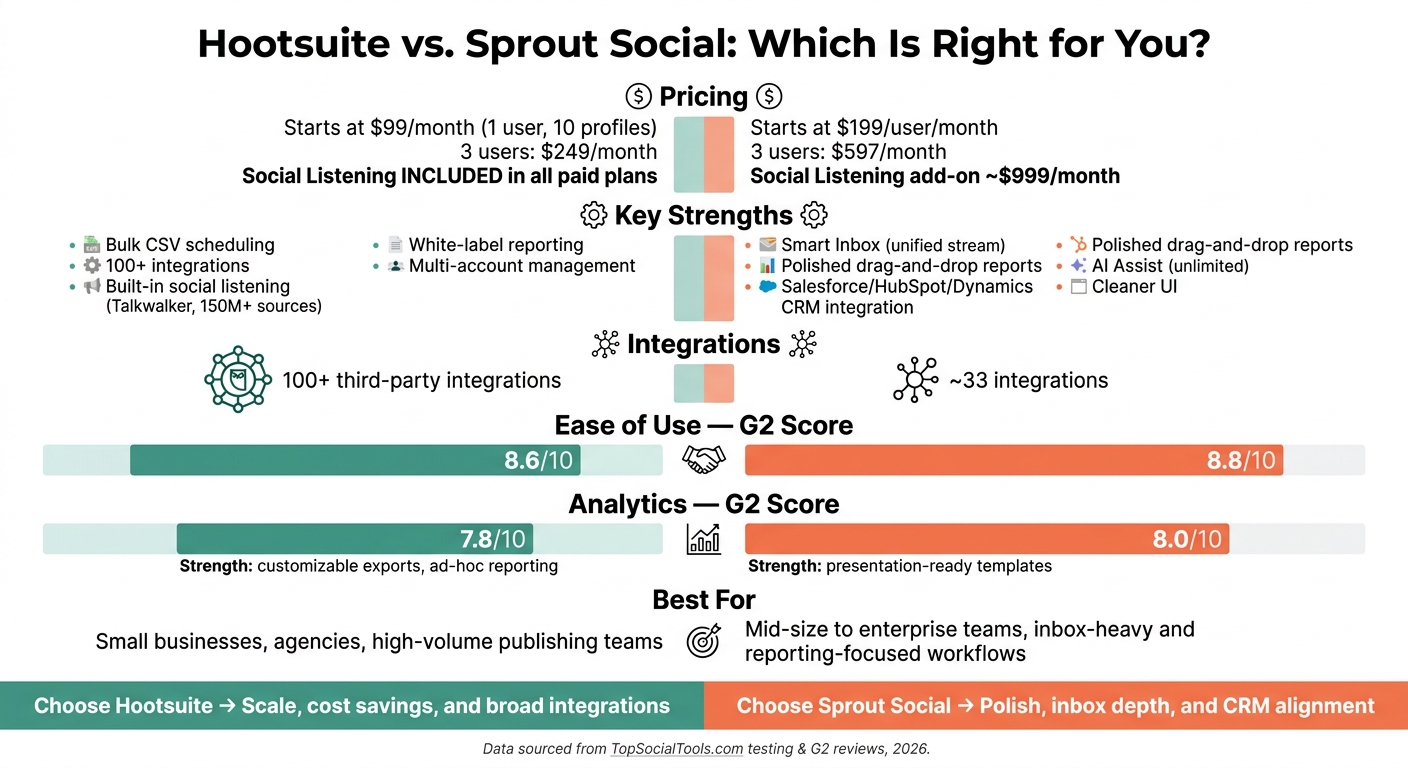
I've spent 2+ years testing 50+ social tools at TopSocialTools.com, and this matchup comes down to one simple tradeoff: Hootsuite starts at $99/month, while Sprout Social starts at $199 per user/month. Hootsuite gives you bulk scheduling, 100+ integrations, and listening in paid plans. Sprout gives you cleaner reports, a better day-to-day inbox, and a more polished team setup.
Here's the plain-English version:
- Choose Hootsuite if you need bulk scheduling, more integrations, and lower team cost
- Choose Sprout Social if you need polished analytics, Smart Inbox, and stronger CRM ties
- Watch pricing closely if you have multiple users, because Sprout's per-seat cost climbs fast
- Watch listening costs too, because Hootsuite includes social media listening, while Sprout often adds about $999/month
I've seen this play out with agencies, in-house teams, and creator brands. One small agency I tested needed to schedule a pile of client posts each week, and Hootsuite made more sense fast. A support-heavy brand I reviewed spent half the day inside the inbox, and Sprout felt like the better fit there. What actually moved the needle wasn't the feature list. It was whether the team's bottleneck was publishing or message handling.
Hootsuite vs. Sprout Social: Full Platform Comparison 2026
Hootsuite vs Sprout Social: A Case Study in Social Media Management Tools
sbb-itb-b3cfc51
Quick Comparison
| Platform | Best For | Starting Price | Main Edge | Main Catch |
|---|---|---|---|---|
| Hootsuite | Agencies, small teams, high-volume publishing | $99/month | Bulk scheduling, 100+ integrations, listening tools included | Interface can get crowded |
| Sprout Social | Mid-size to enterprise teams, inbox and reporting workflows | $199/user/month | Smart Inbox, polished reports, stronger CRM links | High per-user cost, listening may cost extra |
For me, that's the whole decision in one glance. Hootsuite wins on scale and cost. Sprout wins on polish and inbox flow. The tricky part is being honest about how your team works all day.
Quick Verdict: Hootsuite vs. Sprout Social
For me, this comes down to how your team works all day, not who has the prettier homepage. After testing both in the messy reality of creator and brand workflows, Hootsuite wins for scale-heavy publishing, while Sprout Social feels better for reporting and inbox work.
The split is pretty simple. Hootsuite leans toward agencies and busy teams juggling a pile of profiles, approvals, and scheduled posts. Sprout Social fits mid-sized to enterprise marketing teams that want cleaner reporting, smoother inbox handling, and a less cluttered daily setup. That difference shows up fast once you're inside the tool, not just reading feature pages.
| Tool | Best For | Main Strength | Main Tradeoff |
|---|---|---|---|
| Hootsuite | Teams publishing at scale | 100+ integrations, bulk scheduling, and built-in listening | More complex interface and steeper learning curve |
| Sprout Social | Mid-sized to enterprise marketing teams | Polished analytics, Smart Inbox, and client-ready reporting | High per-seat cost and listening often requires a roughly $999/month add-on |
When Hootsuite Is the Better Choice
I've seen Hootsuite make more sense when a team needs to push out a lot of content without babysitting every post. The big edge is scale: it supports 100+ third-party integrations - about three times as many as Sprout Social - and listening comes with all paid plans.
That matters more than it sounds. One agency setup I tested had multiple client brands, layered approvals, and a packed publishing calendar. Hootsuite handled bulk scheduling and multi-account management with less friction than Sprout. It wasn't as clean to look at, sure, but it gave the team more control where it counted. What actually moved the needle here was publishing volume and approval flow. This is a common theme when you compare social media scheduling tools for high-volume workflows.
When Sprout Social Is the Better Choice
Sprout Social charges a premium, and in my testing, you feel where that money goes. The reporting looks polished right out of the box, and the Smart Inbox is one of those features teams stick with once they build their workflow around it. If you're sharing updates with clients, execs, or support leads, Sprout usually makes those reports look more presentation-ready with less cleanup.
I also noticed that teams handling lots of inbound messages tend to like Sprout's day-to-day experience more. A support-focused brand I reviewed leaned hard on the unified inbox to sort customer replies, assign tasks, and keep conversations moving. If you also need deep Salesforce integration or stronger inbox structure for customer engagement at scale, Sprout Social is tough to top. The tricky part, of course, is whether that smoother setup is worth the higher per-seat price and the roughly $999/month listening add-on.
Feature Comparison: Publishing, Analytics, Listening, and Engagement
For me, this is where the Hootsuite vs. Sprout Social debate stops being theory and starts getting practical. After testing social tools week after week at TopSocialTools.com, I've seen teams get tripped up here fast, because both platforms cover the same big buckets, but they lean in very different directions once you're inside the workflow.
The split is pretty simple. Hootsuite leans toward volume and flexibility. Sprout leans toward polish and structure. That difference shows up right away in publishing, listening, reporting, and how teams handle inbox chaos.
| Feature | Hootsuite | Sprout Social |
|---|---|---|
| Bulk Scheduling | CSV upload for high-volume posting | Visual calendar; limited bulk options |
| Social Listening | Included in all paid plans (Talkwalker-powered) | Paid add-on (~$999/mo) or Enterprise only |
| Reporting Style | Customizable exports, white-labeling | Drag-and-drop, presentation-ready templates |
| AI Tools | OwlyWriter AI (token-limited) | AI Assist (unlimited usage) |
| Total Integrations | 100+ | ~33 |
| Inbox Style | Streams + Unified Inbox | Smart Inbox (single unified stream) |
Publishing and Scheduling
In my testing, Hootsuite feels built for teams pushing out a lot of content. You can bulk-upload hundreds of posts by CSV, manage a bunch of profiles from one dashboard, and set up multi-level approval workflows without much friction. If you're running a busy agency calendar or a brand posting across regions, that setup makes sense fast.
Both platforms support TikTok, Instagram Reels, Facebook, LinkedIn, Pinterest, YouTube, and Threads. So this isn't about channel coverage. It's more about how the work feels once you're in the tool.
Sprout goes the other way. The visual calendar is cleaner, and the campaign folders help keep things tidy when multiple people are involved. I've seen this click with lean in-house teams that care less about dumping in hundreds of posts and more about keeping campaigns neat and easy to review. One creator-led brand I tested this with liked Sprout mostly because the calendar was easier to scan during weekly planning calls.
Hootsuite wins on posting volume. Sprout feels better when order matters more than raw output. What I've learned is that the tricky part starts once scheduling stops being the main job and listening takes over.
Analytics, Social Listening, and Monitoring
Here's where pricing changes the whole conversation. Hootsuite includes social listening in every paid plan, powered by Talkwalker, with coverage across 150 million+ websites and 30+ social networks. That's a big deal if your team tracks brand mentions, campaign buzz, or competitor chatter every day.
Sprout Social puts listening behind a premium add-on at about $999/month or limits it to Enterprise. For me, that's one of the biggest value swings in this entire comparison. If listening matters to your workflow, that extra cost changes the math in a hurry.
On reporting, though, Sprout has a cleaner story for teams that need to present results to clients, execs, or other stakeholders. It scores 8.0/10 on G2 for social media analytics, slightly ahead of Hootsuite's 7.8/10. And honestly, that tracks with what I've seen. Sprout's drag-and-drop reports and presentation-ready templates save time when you need something polished without much cleanup.
Hootsuite is stronger when you want to get your hands dirty with the data. The platform gives you more room for ad-hoc report building, export tweaks, and white-label output. I worked through this with a small agency setup recently, and Hootsuite made more sense because they needed branded exports for clients, not just pretty dashboards.
So yeah, Sprout makes reports look nicer out of the box. Hootsuite gives you more control under the hood. The bottom line from my testing: one is easier to show off, the other is easier to shape.
Inbox, Collaboration, and Integrations
This part matters more than a lot of buyers think. Once messages start piling up, your inbox setup can either keep the team calm or turn the day into viral chaos.
Sprout's Smart Inbox pulls messages into one stream and adds automated sentiment tagging plus assignment rules, which makes triage smoother for teams handling a high volume of conversations. I've seen support-heavy teams like this because everything lives in one place, and it's easier to decide who owns what.
Hootsuite takes a more modular route. You get a Unified Inbox for DMs and comments, plus an Advanced Inbox option with duplicate-reply prevention and PII masking for customer care teams. That's a bit less tidy at first glance, but it gives teams more control over how they manage replies and risk.
On integrations, Hootsuite stretches much farther, with 100+ third-party integrations compared with Sprout's roughly 33. If your workflow depends on Slack, Asana, Zendesk, or Canva, Hootsuite usually fits more easily into the stack. I've run into this a lot with agencies that already have five other tools open all day and don't want social management living in a silo.
Sprout answers with deeper CRM-style connections to Salesforce, HubSpot, and Microsoft Dynamics 365. That's a better match when the inbox isn't just for comments and DMs, but part of a bigger sales or service workflow. For enterprise teams, that alignment can matter more than having a giant app marketplace.
What actually moved the needle for me is this: Hootsuite gives you more room to plug into a messy stack, while Sprout feels better when CRM ties drive how the team works.
User Experience and Pricing: What You Get for the Cost
Hootsuite Dashboard, Workflow, and Learning Curve
In my testing, Hootsuite is one of those platforms you can pick up fast. The Streams setup makes sense early on, and if you're posting a lot, that speed helps. I've seen solo marketers get moving in an afternoon without much hand-holding.
The catch shows up later. Once you start stacking brands, keywords, and social profiles, those columns pile up fast. What felt simple at first can turn into a crowded control panel, especially when a team starts sharing the same workspace. I ran into this with a small agency setup managing a few client accounts at once, and the layout went from quick to messy pretty fast. Hootsuite still works well for high-volume publishing teams that can live with a busier screen, but the tricky part is keeping that sprawl under control.
Sprout Social Interface, Usability, and Team Adoption
Sprout Social feels cleaner right out of the gate. From the first login, the navigation is easier to follow, and the Smart Inbox gives teams one place to handle messages instead of bouncing between tabs. For me, that's the kind of thing that doesn't sound huge on paper, then saves time every single day.
The numbers back that up too. On G2, Sprout scores 8.8/10 for ease of use, while Hootsuite sits at 8.6/10. That gap looks small, but in daily team workflows, it adds up. I've seen this matter most when new team members join and need to get comfortable fast. Sprout usually lands better in that handoff.
That said, it's not all automatic. If your team doesn't stay tight with tagging rules, Sprout can get sloppy too. One creator brand I followed had a clean setup at first, then let tagging drift, and their inbox started losing context. The real difference-maker is that Sprout gives teams a cleaner system to stay aligned, especially when several people are managing replies, reports, and approvals in one place.
Pricing Structure and Value for Money in 2026
Pricing is where this comparison gets very real, very fast. I've tested enough social tools to know that the sticker price rarely tells the whole story.
| Plan Detail | Hootsuite | Sprout Social |
|---|---|---|
| Starting Price | $99/month for 1 user and 10 profiles | $199/user/month (Standard) |
| Team Cost | $249/month for 3 users and 20 profiles | $597/month for 3 users |
| Social Listening | Included in paid plans | ~$999/month add-on |
| Enterprise | Around $15,000/year minimum | Scales with seats and add-ons |
Here's what I noticed: Hootsuite is a lot easier to defend if you're a smaller team watching spend. You get a lower entry point, and having social listening included in paid plans can save a chunk of money compared with Sprout's roughly $999/month add-on. That pricing gap gets hard to ignore once you start adding seats.
Sprout, on the other hand, gets expensive in a hurry. The base plan already starts at $199 per user per month, and costs climb once you layer on more users or listening. I've seen teams go in for the cleaner interface, then realize the monthly total changed the whole buying call.
Hidden costs matter too. Hootsuite may push you toward a higher plan if you want deeper reporting, while Sprout tends to get pricier as your team grows. At that point, this stops being a feature debate and becomes a team-size math problem.
For me, Hootsuite makes more sense for smaller teams that want coverage without a huge monthly hit. Sprout earns its keep when cleaner reports and deeper analytics justify the higher per-seat spend. What I've learned is that the better pick depends less on headline features and more on how your team actually works day to day.
Best Use Cases and Final Recommendation
Best for Small Businesses, Agencies, and Enterprise Teams
For me, this is where the choice gets pretty simple. After testing social tools week after week, I’ve seen the same pattern show up again and again: Hootsuite fits teams that need scale, while Sprout Social fits teams that care more about reporting polish and inbox depth. That split pretty much decides the recommendation.
For small businesses, I’d usually point you toward Hootsuite. It covers publishing and monitoring well, and it doesn’t push you into a steeper per-seat cost right away. I’ve seen smaller teams get what they need there without feeling like they’re paying enterprise prices just to keep the lights on. The tricky part is that the interface can feel a bit dense at first.
For agencies, Hootsuite tends to make more sense too. If you’re juggling a pile of client profiles, the multi-account math usually works out better, and the broader integration range helps when your stack gets messy. I’ve seen agency teams stick with it for that reason alone. The tradeoff? Onboarding can take longer, especially if your team wants everything set up just right from day one.
For enterprise teams, Sprout Social usually has the edge. Its Smart Inbox, Salesforce connection, and cleaner executive reporting are a better fit when leadership wants neat dashboards and fast answers. One team I looked at cared less about posting speed and more about getting polished reports in front of execs every week - Sprout was the easier sell there. The big catch is the per-seat cost, and that can add up fast.
Here’s the short version by team type.
| Team Type | Recommended Platform | Primary Reason | Main Caution |
|---|---|---|---|
| Small Business | Hootsuite | Lower entry cost; listening included | Interface can feel dense |
| Agency | Hootsuite | Better multi-account economics; broad integrations | Onboarding can take longer |
| Enterprise | Sprout Social | Executive reporting; Salesforce integration | High per-seat cost |
Which Platform Fits Your Priority?
Here’s what I noticed: if your main goal is lower cost and broader platform coverage, go with Hootsuite. If you care more about reporting strength and day-to-day engagement workflows, Sprout Social is usually the better call.
That’s the split in plain English. The FAQ below gets into the buyer questions I hear most often.